Thursday, November 30, 2017

The Aggregate Corporation Tax Computation for Companies with No Net Income

Among the Corporation Tax Statistics provided by the Revenue Commissioners is a breakdown of a number of the items that make up the aggregate corporation tax computation by range of net income.  Here we will look at the recent outturns for companies reporting “nil or negative” net trading income.  With no net trading income it might suggest that there is little going on from a tax perspective but that is far from the case.

The table below provides the aggregate computations for “All Companies” and for “Companies with no Net Income”.  Some items are not provided in breakdown used but more than enough is provided to see what is going on.  It should also be noted that this breakdown is done by individual entity so while a company or group may have an entity with no net trading income this does not mean that the group as a whole does not have net trading or other taxable income with tax liabilities associated with that.  Anyway here they are: 

Corporation Tax Computation for Companies with No Trading Income

In the panel on the right we can see the line of duck eggs in the row for Net Trading Income but there is a lot going on both above and below that.

At the top we can see that companies with no Net Trading Income had Gross Trading Profits of just over €40 billion, a rise of €26.5 billion.  Net income is derived by subtracting capital allowances and previous trading losses carried forward.  The dataset gives the amount of these that are available rather than used but the effect of them is to reduce the starting figure for gross trading profits to a net figure of zero. 

Most of the losses likely relate to financial institutions and a large portion of them will likely never be used as some of the companies are in liquidation.  The use of previous losses is only possible if there are current gross trading profits against which to offset them.

The changes for capital allowances are more interesting.  In 2015, the amount of capital allowances available for all companies increased by €27.8 billion.  We can see that of that €25.6 billion was related to companies with no Net Trading Income. 

Thus we have an increase of around €26 billion in the gross trading profits offset by an increase of around €26 billion in capital allowances resulting in a net trading income of nil. 

Moving down the computation we can see that while these companies might have no net trading income they do have significant amount of other income and in particular foreign income.  In 2015, the Total Income of companies with no net trading income was over €10 billion with almost €8 billion of this being Foreign Income.  The remainder is made up of capital gains (regrossed to reflect the difference between the rate of Corporation Tax and Capital Gains Tax) and net rental income.  Since 2011, around 70 per cent of the income in these categories has arisen in companies with no net trading income.  In most years,  these companies had limited deductions to use against this and in 2015 the €10 billion of other income translated into a Taxable Income of €9.3 billion.

We don’t get a breakdown of gross tax due by range of net trading income but applying the 12.5 per cent rate would give a rough approximation of around €1.1 billion.  We can see from the bottom line that the amount of Tax Due was €177 million and that almost all of that reduction is the result of €730 million of Double Taxation Relief granted to these companies in 2015.  The €177 million of tax due likely arises due to rental, capital gains and other income earned by companies in this group.

The foreign income included in the table relates to external activities of Irish-resident companies.  This is in the Corporation Tax computation as Ireland has a worldwide regime and remitted branch or related company dividends are included in the Taxable Income base.  To avoid double taxation a relief is granted in the form of a foreign tax credit.  This credit is one of the main reasons the tax due as a proportion of taxable income is below 12.5 per cent (as shown it was 9.6 per cent in 2015)

The data by range of net income shows that almost 80 per cent of the €948 million of Double Taxation Relief granted in 2015 was to companies with no net trading income.  In overall terms there are ten of thousands of companies in this category but Double Taxation Relief was granted to just 413.  In 2015, there was also €213 million granted under the Additional Foreign Tax Credit.  This is included under “Other Tax Relief” in the table above but is only available for all companies as a breakdown by range of net income is not provided.

It is likely we are dealing with a small group of Irish-resident companies.  These companies may have no or limited domestic trading activities though other companies in the group may have significant operations, and tax liabilities, here.  These companies have large amounts of foreign income included in their Taxable Income in Ireland but the application of the various double tax reliefs will significantly offset their gross tax due in Ireland.  The end point of tax due as a proportion of taxable income was 1.9 per cent for for the group of companies with no net domestic trading income in 2015.

As a result of these large foreign profits and small tax amounts due in Ireland it is likely that these companies make up a significant proportion of the 13 companies from the Top 100 ranked by Taxable Income identified by the Comptroller and Auditor General as having effective tax rates of 1 per cent or less.  We looked at this at the time here

While the Irish tax due on these foreign profits may be nil it will be the case that the companies will have paid amounts of foreign tax on these profits (that it why they are getting the foreign tax credit) so that the effective tax rates of the companies (as opposed to just their effective rate of Irish tax) will much higher. 

If we want to remedy some of the near-zero effective tax rates identified by the C&AG one solution would be to move to a territorial which would take large amounts of foreign income out of the Irish tax base and negate the need to provide a foreign tax credit.  This would reduce companies Taxable Income to that generated by their Irish activities (or any income attributed to their Irish activities by any CFC rules Ireland might introduce) and the effective tax rate would be much closer to 12.5 per cent.  The C&AG report that 79 of the Top 100 companies had effective tax rates above 10 per cent with 59 having effective tax rates greater than 12.5 per cent.  Moving to a territorial system would increase those numbers.

The second main reason for the low effective tax rates identified by the C&AG is the R&D tax credit.  We do get a breakdown of the R&D credit used against tax in the current year by range of net income.  As shown above just €2 million of the €349 million of the credit used in this manner in 2015 was for companies with no net trading income and this was spread across 94 companies.  The figures show that €302 million went to 99 companies with to net trading incomes greater than €10 million.

When looking at low effective tax rates it would probably be much more informative to look at the distribution of the €359 million of the R&D tax credit that was paid to companies as the credit they were entitled to exceeded their tax liability. Unfortunately a breakdown of this component of the R&D tax credit is not provided in the Revenue statistics. 

The very fact that this is a payment of an excess credit means that these companies will have a negative effective tax rate.  We do not know how many such companies  are in the Top 100 as set out by the C&AG but again note, that like the foreign tax credit, it is a logical explanation, and deliberate policy choice, behind the low effective tax rates identified by the C&AG. 

So, if we want to further remedy the low effective tax rates the solution in this instance is to abolish the R&D tax credit.  Do that and even more of the Top 100 will have effective tax rates close to 12.5 per cent. 

The Revenue Commissioners have actually considered this and in recent evidence to the Public Accounts Committee, the Chair of the Revenue Commissioners said:

…if the effective tax rate of each of the 13 companies is calculated before taking account of double tax relief and the R&D tax credit, each would have an effective tax rate in excess of 12%.

So this really is only something to get excited about unless we think companies are paying tax elsewhere or incurring R&D expenditure to avoid Irish taxes.  If anything the C&AG report confirms that the Taxable Income of companies is taxed at close to the 12.5 per cent rate.  It is in the determination of that Taxable Income where most of the action is.

Friday, November 24, 2017

Very Low Work Intensity by Household Type

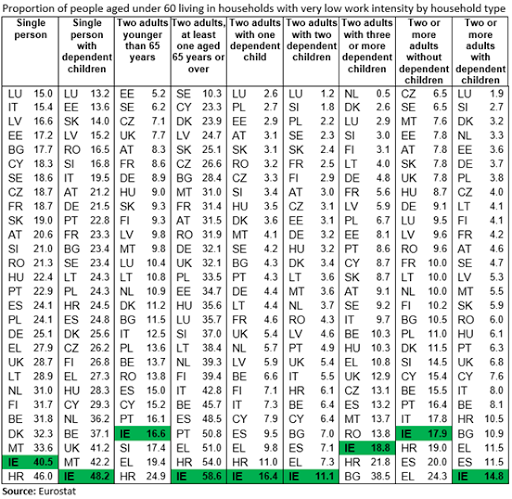
Ireland’s rate of people living in households with very low work intensity has received increased attention over the past few years.  It’s not hard to see why.

Very Low Work Intensity 2015 2

It could be that this is an issue of composition.  That is, maybe our population structure is such that we have a greater proportion of households with a higher tendency in general towards the end of the work-intensity scale.  Looking at very low work intensity by household type should throw some light on this.

Very Low Work Intensity EU28

So is it an issue of composition? No.  There is no household type for which Ireland are better than fourth last.  We have very low work intensity across the board.

Thursday, November 23, 2017

Computation and Concentration of UK Corporation Tax

Ireland’s Corporation Tax statistics get a fair bit of attention.  Similar statistics are produced for the UK by HRMC.  First up the aggregate Corporation Tax computation.

UK CT Comp

The common origins of the two systems mean that many of the descriptions are similar and it follows a form similar to the Irish version (the most recent update of which can be seen here).

For the UK we can see that the starting point of Gross Trading Profits and after subtracting capital allowances and other deductions and adding Other Income & Gains we get to Total Chargeable Profits.  The applicable rates are set against this to give the Total Tax Charge and after allowing for reliefs and set-offs we get to the bottom line: Corporation Tax Payable.

The sequence of numbers shown above don’t necessary add to the outcomes shown as in some cases (such as capital allowances) the amounts are those available in the year rather than those actually offset against profits in the year as losses brought forward are not included in Net Trading Profits.

The majority of Chargeable Profits are taxed at the Main Rate.  This has been reduced over the past decade (it was 30 per cent in 2008) and for the period shown in the table above there were reductions every year as it fell from 26 per cent to 20 per cent.  This has the effect of reducing the “tax payable as a % of chargeable profits” figure in the final row. 

This figure is fairly close to the Main Rate for all years and it can be seen that the largest item reducing the Total Tax Charge is Double Tax Relief which relates to non-UK tax already paid on non-UK profits included in the Chargeable Profits of companies.  This is also a key reason why this measure of below the 12.5 per cent headline rate for Ireland though it has been joined by the R&D tax in recent years as explored here

A second issue of relevance to Ireland is the concentration of payments.  Statisticians from the Revenue Commissioners have done excellent work on this recently and we now know that 10 companies account for around 40 per cent of Irish Corporation Tax payments.  For the UK the key points on concentration made in the HMRC report are:

Key points:

1. The distribution of companies’ tax liabilities is highly skewed. In 2015- 16 about 7,000 companies (under 1 per cent) had liabilities of £500,000 or more, between them contributing around 54 per cent of total Corporation Tax payable.

2. Companies with liabilities of less than £10,000 comprised about 65 per cent of the total number of companies liable for corporation tax in 2015- 16, but owed only around 7 per cent of the total Corporation Tax payable.

3. In 2015-16, around 50 companies had more than £50 million each in Corporation Tax liabilities (totalling £5.4 billion or 12 per cent of the total Corporation Tax payable). The figures for 2014-15 were around 60 companies paying £6.9 billion or 16 per cent of the total Corporation Tax payable.

4. There was an increase of around 140 thousand in the number of companies with any liability between 2014-15 and 2015-16. This increase was largely concentrated in companies with a Corporation Tax liability of under £50,000.

So the receipts are concentrated but not anything near to the same extent as they are in Ireland.

Finally, the HMRC report has lots of detail on the use of capital allowances – but there is no mention or breakdown provided for capital allowances for capital expenditure on intangible assets. Pity.

Tuesday, November 21, 2017

Ireland’s capital stock continues to expand

The CSO have provided the 2016 update of Ireland’s fixed capital stock.  This has been affected in recent years by aircraft for leasing and intangible assets.  This continued in recent year.

Here is Ireland’s gross capital stock in 2015 prices.

Gross Capital Stock Constant Prices

This measure gives an estimate of the amount of fixed capital held at the end of each year.  Gross depreciation is not taken into account and the amounts reflect the value of the fixed assets (in 2015 prices) as if they were new.  Changes are the result of additions to the capital stock and obsolescence of existing fixed assets.

There have been a number of data suppressions in recent years which means that we only have a combined category for aircraft and R&D intangible assets.  There were increases in all categories of fixed assets though the largest contribution to the overall increase came from aircraft and IP.

Unsurprisingly it is estimated that there was a very small increase in the stock of dwellings, rising by just one per cent in 2016.  Other buildings and structures rose at an appreciably faster pace at 4.5 per cent.

Next is a net measure of the capital stock which accounts for depreciation.  This better reflects the value in use of fixed assets rather than their replacement cost.  Again we will consider this in constant prices to look at changes in the quantity of assets from year to year.

Net Capital Stock Constant Prices

We know there were large depreciation charges for aircraft and IP over the past few years (it is was it messing up the GNP and GNI figures) but we can see that even accounting for depreciation the stock of these assets increased by almost five per cent in 2016.  They are still arriving faster than the existing stock is depreciating.  Again on dwellings it is not surprising to not that our stock of dwellings barely changed in 2016, with a rise of just 0.5 per cent.

And finally, here are the change in the depreciation on these assets (again in constant prices)

Consumption of Fixed Capital

Although the increase in depreciation in 2016 was much lower than the huge-level shift that occurred in 2016 we can see that around three-quarters of the 2016 increase is due to aircraft and intellectual property.  This, of course, matches the first table where we saw that an equivalent amount of the increase in the gross capital stock was related to these assets which have few direct links to activities in Ireland.  The aircraft are flying all over the world and many of the products that are derived from the IP are made in other countries with the R&D behind it all also having being undertaken elsewhere.

The figures for “total ex. aircraft and IP” at the bottom of each of the tables give a better indication of the underlying changes in Ireland’s capital stock.

Monday, November 20, 2017

Non-Profit Institutions Serving Households

As well as giving a split of the non-financial corporate sector the 2016 institutional sector accounts also give a split for the household sector.  Up to now households (S.14) and non-profit institutions serving households (S.15) were combined.  We now have separate current and capital accounts for each.  Non-profit institutions serving households (NPISHs) are relatively small in the overall scheme of things (they are around two per cent of the combined sector) but we do get to see how they are funded and what, in rough terms, they spend the money on.

It should be noted that this doesn’t cover all charitable or voluntary organisations many of which are counted in the government sector given the nature of their links to the public sector.  As the CSO note:

Many charities, such as hospitals and social care providers, which receive most of their funding from government and which provide services under contract with government, are treated as part of the government sector (S.13) in national accounts, and not S.15.

Anyway here is the aggregate current account of those entities included in this sector.

NPISHs Sector Current Account 2012-2016

On the income side we can see that these institutions had around €3.3 billion of income in 2016.  Most of this came in the form of transfers with around €780 million raised from their own activities.  The CSO note:

The institutions in the NPISH sector get most of their income as transfers from households (for example donations, church collections, union dues or members' subscriptions) and also receive transfers from government.  They also earn profits on their market activities, such as charity shops and match tickets.  Relatively little of their income is from investments.

On the current expenditure side almost all goes on compensation of employees and final consumption expenditure which between them were €3.2 billion in 2016:

Their income is spent on final consumption expenditure and compensation of employees in a roughly 3:1 ratio. There are over 55,000 people in direct paid employment in the NPISH sector.

Expenditure on staff was €1.14 billion in 2016 which gives an average of €20,700 per person in direct employment.  We also get a capital account for the sector but there isn’t a whole lot going on there.

NPISHs Sector Capital Account 2012-2016

For the past few years the gross capital formation of the sector has been less than the gross saving from the current account and investment grants received shown here.  This has resulted in the sector being a net lender averaging around €45 million for the past three years.  The figures for net capital formation are positive which means that gross capital formation was lower than the consumption of fixed capital (depreciation).

Printfriendly