Showing posts with label Promissory Notes. Show all posts

Monday, September 23, 2013

The Promissory Note “savings” revisited

As outlined in the previous post it was projected in the Budget last December that the 2014 deficit would be €8.9 billion.  Just four months later the forecast of the 2014 deficit in April’s Stability Programme Update was €7.7 billion, a decrease of €1.2 billion.

The improvement was due to two things.  The first was around €200 million of revenue buoyancy from taxes that performed better than expected in the final 2012 outturn with carryover effects into 2013. 

The other €1 billion of deficit reduction in the projections was due to the “saving” from the Promissory Note restructuring. This arrangement did have the effect of improving the general government deficit for 2014 by around €1 billion (and subsequent years by declining amounts of around €100 million lower) but the change would not necessarily satisfy the dictionary definition of a saving.

The Anglo/INBS disaster resulted in a capital shortfall of around €35 billion in order to cover their massive loan losses and satisfy their depositor/bondholder liabilities that were repaid. A €4 billion cash injection was given to Anglo in 2009 with the other €31 billion being provided through Promissory Notes (a promise to pay in the future) in 2010. Two payments of €3 billion were made on the notes, one in 2011 and 2012, though the 2012 payment was made with a 2025 government bond rather than cash, meaning that there was around €25 billion of the Notes remaining when the restructure was put in place back in February.

Under the old arrangement, the Exchequer paid interest to the IBRC (the merged entity of Anglo/INBS) as the holder of the Promissory Notes. The IBRC was able to use this money, and the capital repayment portion of the €3 billion payment, to reduce its Exceptional Liquidity Assistance (ELA) liabilities with the Central Bank.  The IBRC used the ELA money from the Central Bank to repay its depositors/bondholders and as the loans it held were not going to be repaid sufficiently to, in turn, repay the Central Bank the money from the Promissory Notes was set to make up the shortfall.

Although the IBRC was outside the general government sector for Eurostat deficit measurement purposes, it was a 100% state-owned entity so the interest payment on the Promissory Notes was not going to an external third party.

The IBRC was itself paying interest to the Central Bank of Ireland for access to the ELA and some of that interest was returned to the Exchequer via the Central Bank surplus on its operations. The net external cost of the arrangement was the interest the Central Bank had to pay into the ECB for the facility to create money under the ELA scheme. The cost of this was the ECB’s Main Refinancing Operations (MRO) rate. This is currently 0.5%.

The interest on the Promissory Notes was high (around 8% from 2013) and fixed but was paid to the IBRC which in turn used it to pay down its liabilities with the Central Bank who then used it to reduce the amount of ELA it had forwarded. The interest rate on the Notes was largely meaningless and as Prof Karl Whelan usefully explained the €3 billion repayment would have resulted in the ELA liabilities to the Central Bank being fully repaid by 2022 even though the Promissory Note repayment schedule extended to 2030.

The IBRC was making a massive interest profit on the Promissory Notes and could use this to repay its only remaining liabilities – to the Central Bank of Ireland. As the IBRC was 100% state-owned the extra interest because of the high rate on the Promissory Notes was merely allowing the repayment of the money used to bailout Anglo/INBS depositors to be repaid quicker. 

The high interest rate on the Promissory Notes did not result in any additional direct costs, so a lower interest rate could not result in any direct savings.

Upon the liquidation of the IBRC, the Promissory Notes were cancelled, and the €25 billion owing to the Central Bank under the old arrangement was replaced with €25 billion of long-term bonds. As with the Promissory Notes the Exchequer is liable for the interest due on these.

Under the Promissory Notes the high interest rate on the €25 billion meant around €1.8 billion was due to be charged to the general government sector in 2014. Under the new arrangement the Central Bank holds €25 billion of long-term government bonds and the floating interest rate on these (currently around 3%) means that an interest bill of around €0.8 billion will be due to the Central Bank next year.

The difference between the figures is the €1 billion “saving” from the Promissory Notes restructuring.

However, just like the ELA arrangement the Central Bank will return any profit it makes from holding the bonds to the Exchequer through the Central Bank surplus. The Central Bank is a state-institution but as the monetary authority it is outside the definition of the general government sector used by Eurostat.

The net external cost to the broader or overall government sector is the cost to the Central Bank of creating the €25 billion to ‘buy’ these bonds from the government. The net external cost is just as it was under the old Promissory Notes/ELA arrangement; it is the ECB’s MRO. There is no actual interest rate saving from the restructuring, so the €1 billion “saving” is illusory though it does appear in the general government accounts. The  cost of the debt to the State disaster remains the same.

There is, though, a saving because the repayment schedule of the €25 billion has changed. Under Promissory Note arrangement the relatively cheap Central Bank funding (at the ECB’s MRO) would have been repaid by 2022. Under the new schedule which gives the minimum rate at which the Central Bank must sell the new bonds access to the funding at the MRO will be extended to 2032. See this earlier post.

There are benefits from the restructuring but they come about because of the slower rate at which the Central Bank sells the new bonds (meaning the interest is paid to a third-party and not recycled back to the Exchequer) compared to the repayment schedule on the former Promissory Notes (requiring borrowing to fund the €3 billion annual payments and thus interest to be paid to a third-party).

The new arrangement delays the rate at which a low-cost Central Bank liability (ELA/money to hold bonds in trading portfolio) is transformed into ‘normal’ government debt with the associated interest costs. The actual savings will be at their greatest roughly between 2016 and 2023 (assuming the minimum resale schedule is adhered to).

Of course, for the Excessive Deficit Procedure it is the general government deficit as defined by Eurostat that matters when it comes to the budget. But some consideration can easily show that the government moving from paying €1.8 billion of interest to the former IBRC to €0.8 billion of interest to the Central Bank doesn’t matter in the broader scheme of things as both have the government as their sole shareholder.

There is no “extra” €1 billion because of the Promissory Note arrangement.  The capital hole in Anglo/INBS was not reduced because of the change.  Nobody said we had to pay €1 billion a year less to pick up the bill.  The interest on the Promissory Notes was not a cost so a reduction in that interest is irrelevant.  It is the ECB’s MRO and how long funding at that rate can be accessed that matters.  There will be a small saving in 2014 on that front because of the Promissory Note restructuring but it will probably be around €100 million.

If there is to be a reduction in the fiscal consolidation in next month’s budget the argument has to be framed about why we should run a larger primary deficit now so that future generations can carry our “legacy of debt”.  And it is to primary balances that we turn next.

Friday, February 8, 2013

Interest costs under the “debt deal”

As explained in the previous post it is not the size of the government debt that has a direct impact on the public finances; it is the interest cost it generates (though the size is obviously a big factor in that) 

What was in play with yesterday’s restructuring was a €25 billion Promissory Note debt.  It was a €25 billion debt on Wednesday, it is a €25 billion debt today and it will be a €25 billion debt in 2053.  But because of inflation not all €25 billions are created equally.

Anyway, the debt in question generates two interest costs for the State:

  1. The interest on the central bank funding which carries an interest rate equals to the ECB’s main refinancing rate.
  2. The interest on the borrowings used to pay down the central bank liquidity.

Here are two tables that showing some hypothetical the interest costs of the old Promissory Note and new Long-Term Government Bond arrangements until 2033. 

These are only hypothetical scenarios designed to gauge the relative difference in the cost of each approach rather than a definitive estimate of the cost of each.  There are a number of simplifying assumptions made.

  • The ECB interest rate is expected to rise from 0.75% to 3.00% over the next six years and stay at 3.00% thereafter.
  • The ‘margin’ of Irish government borrowing over the ECB rate is assumed to be constant 3.25%.
  • All interest is paid from current revenue.
  • Borrowings are only made to fund capital payments.  This only impacts the Promissory Note arrangement and from each €3.1 billion annual payment the Central Bank profit is subtracted as it is returned to the Exchequer and also the external interest cost of the ELA as it is assumed that is paid from current revenue.  This keeps the borrowing at €25 billion in both cases so we can assess the interest cost.
  • The discount rate used is 6%.

As we are looking for relative differences the assumptions are not hugely significant as both scenarios are played out under the same set of assumptions.

First the Promissory Notes:

Pro Note Interest

And the new Long-Term Bond arrangement:

Long Term Bond Interest

The interest mix of both changes.  In the first case it is because the Promissory Notes/ELA costing the ECB rate is paid off with new government borrowings at the “market rate”, while in the second case the Central Bank funding at the ECB rate is reduced through the Central Bank selling the bonds it holds thereby making the interest payable to a third party. By 2034 both arrangements are identical in this setting - a debt of €25 billion with an annual interest cost of €1.56 billion (assumed interest rate by then is 6.25%) - as all the Central Bank funding is repaid

So what do we find in? In nominal terms the interest costs are

  • Promissory Notes: €27.0 billion
  • Long-Term Bonds: €20.6 billion

Getting the present value of the interest payments gives:

  • Promissory Notes: €14.3 billion
  • Long-Term Bonds: €10.3 billion

The interest cost under the new arrangement is around 30% lower.  This is a gain to the State of the new change which arises from having access to borrowings at the lower ECB rate for longer.  It increases from c.7 years to c.15 years.

The are other gains from the new arrangement.  The above just reflects the interest cost of each arrangement.  The accounting treatment of the Promissory Notes meant they had a very large impact on the deficits over the coming years.  That has now been reduced.  Also the new arrangement means that the debt doesn’t have to be rolled-over until the first of the new bonds matures in 2038 significantly reducing the medium term funding needs of the State. 

The is little doubt that the new arrangement is anything other than a gain for the State.  And unless your expectations were incredibly unrealistic (or more accurately based on fantasy), yesterday’s announcements were pretty much as good as could have been hoped for given the institutional constraints faced.

“Legacy of Debt”

Lots of talk about a “legacy of debt” in response to yesterday’s re-arranging of the Promissory Notes/ELA framework.  First up, governments don’t repay debt, they roll it over.  And, as well as the size of the debt, there are two things that matter for debt rollovers:

  • average maturity
  • average rate of interest

Today’s announcement does not change the size of the debt but the maturity and interest rate changes are very significant (and beneficial in case there is any confusion).

Yesterday, Ireland was faced with the prospect of carrying a debt of €25 billion on the Promissory Notes and needed to roll that over with payments of €3 billion every year at whatever the best available rate at the time was.

At the end of the Promissory Notes (which would probably have been around 2022) the debt would still exist and what would need to be rolled over would have been the borrowings undertaken in the interim to meet the €3 billion annual repayments.  This legacy of debt was always going to exist and would have needed to rolled over in 2025, 2035, 2045 or whenever.  Government debt is not extinguished, the burden of carrying it (the interest) is eroded through growth and inflation.

Yesterday’s announcement offers some significant benefits for Ireland on both fronts.  Firstly, the average maturity has been extended to an average of 34 years.  This means the debt has to be rolled over far less frequently and through that reduces risk.  Under the current arrangement there would be €25 billion of debt being paid off in chunks of €3 billion and these would quickly accumulate into a total of tens of billions that would need to be frequently rolled over depending on the nature of the borrowings used to fund the annual payments.

The new arrangement postpones this roll over to an average duration of 34 years.  Rolling over €25 billion of debt in 2020 could present significant difficulties.  Rolling over €25 billion of debt on a staggered basis between 2038 and 2053 will be far less onerous.

The new arrangement also offers the significant interest rate benefits.  Under the Promissory Note arrangement debt with a very low net external cost of 0.75% (the ECB MRO rate) was transformed into much more expensive debt (EU/IMF loans at 3.3%) at a rate of €3 billion per annum. 

The net external cost remains at 0.75% but the rate at which the debt is transformed into more expensive debt has been significantly reduced.  As a result of the Central Bank of Ireland selling the bonds it receives as part of the swap this will happen at a rate of €0.5 billion per year up to 2018, €1 billion a year from then until 2023 and €2 billion a year thereafter.

The €25 billion of Promissory Notes would have been turned into full interest-costing sovereign debt by around 2022.  Today’s announcement means that the full €25 billion will not become fully interest-costing until around 2032.  We have gained because the debt with a net external cost of the ECB MRO rate is now available for longer.

Future generations were always going to have a “legacy of debt” of €25 billion.  What yesterday’s announcements have ensured is that they will have access to lower interest rates for longer and will be faced with rolling over the debt less often.  In the arena of public debt both of these are a win.

Here are some figures since 2008:

  • 2008: €10.9 billion
  • 2009: €15.4 billion
  • 2010: €11.8 billion
  • 2011: €10.2 billion
  • 2012*: €7.0 billion
  • 2013*: €3.4 billion

This figures will give a “legacy of debt” of €58.7 billion.  This is more than €30 billion greater than the total in question in yesterday’s restructuring.  What are these figures?  They are the underlying primary deficits (the deficit net of interest costs and banking measures) that the state ran from 2008 to 2011 and the projections of what the primary deficit will be for 2012 and 2013.

This is the excess of government expenditure on public sector pay, intermediate consumption, social transfers, capital formation and subsidies for the current generation over the tax revenue the government is raising from the current generation.  Over a six- year period the government is spending nearly €60 billion more on us in services and transfers than it is collecting from us in taxes and charges.  Why is no one concerned about this “legacy of debt” for future generations?

If we could borrow this money with a zero-interest perpetual bond there would be no need to worry about future generations.  They would have to pay nothing for our borrowings.  This highlights that for governments it is not the amount of debt that matters.  With governments debt doesn’t matter, deficit spending does.

The debt only matters insofar as it generates an interest cost.  If this money has to be borrowed at 4% it will cost future generations over €2 billion a year in interest for the privilege of us spending more on ourselves than we are willing to pay in taxes.  Is this a legacy we are willing to impose on future generations?

Wednesday, February 6, 2013

“Lots of Debt” in the IBRC?

On last night’s Primetime, Professor Hans-Werner Sinn seemed to support a default on the upcoming €3.1 billion payment on the Anglo Promissory Notes.  From the interview:

PK: If, for example, we decide we are not going to pay the 3.1 billion on the Promissory Note which is due at the end of March.  That means that the former Anglo bank will not have the cash to do what it needs to do – to wind down.  The ECB will say “that’s a default”.

HWS: Why don’t you let it default? Default is the best way to solve such a problem. It doesn’t mean the bank comes to an end; it just means that the creditors have to forgive some of the debt and this is quite natural.  They made the investment decision.

And

HWS: Well there is still lots of debt in the banking sector, including the Anglo Irish Bank, the follow-up bank, the bad bank.  It has bondholders; it has creditors.

PK: So burn them?

HWS: Well, ask them to forgive some of the debt.

“Why not let it default?”  That could be done but it is clear that Professor Sinn does not know what is left in Anglo/INBS, now known as the Irish Bank Resolution Corporation (IBRC).  Here is an abridged version of the IBRC balance for the end of June 2012 taken from its latest interim report (page 24)

IBRC Balance Sheet June 2012

IBRC does have a lot of liabilities but 85% of it is the Exceptional Liquidity Assistance (ELA) it drew down from the Central Bank of Ireland in 2010 to repay the huge amount of deposits that left at that time.  The €3 billion of “Deposits from Other Banks” is the repurchase agreement entered into with Bank of Ireland last year with an Irish government bond that was used to meet last year’s Promissory Note/ELA repayment.  The IBRC must repay this in June.

There is not “lots of debt” to renege on unless Professor Sinn means a default on the ELA that is ultimately owed to the ECB and that we should ask them “to forgive some of the debt”.  However, when pressed further he doesn’t seem to advocate this.

PK: The ECB will allow us to do this?

HWS: I don’t know what the ECB will say.

Monday, January 28, 2013

Where was the Xmas “surge” in Retail Sales?

The CSO have released the December 2012 Retail Sales Index.  There is something missing from the data – the much heralded “surge” in retail sales that apparently took place around the Christmas period.  Here is the core retail sales index which excludes the Motor Trades.

Ex Motor Trades Index to November 2012

There was an increase in December but only marginally.  The trend in retail sales is up but this data do not reflect what was feted as “the best Christmas for retailers since 2007”.  Here it might be a little instructive to use the unadjusted series that just looks at the amount of retail sales without taking seasonal factors into account.  This chart has the unadjusted series for core retail sales (with December 2008 equal to 100).

Unadjusted Ex Motor Trades Index to December 2012

Unsurprisingly there is a spike in retail sales each December.  At 94.2, this year’s December peak was higher than each of the last two years (92.5 in 2010 and 93.3 in 2011 using the base in the chart) but was below both 2008 (100) and 2009 (94.7).

Maybe we are not looking in the right place.  It would be great if the CSO provided a resource that allowed us to create selected sub-indices from the categories provided.  The retail sales shown in the above charts include fuel, furniture, hardware, medicines and other categories which were likely excluded when Retail Excellence Ireland were making their seasonal claims.  These items only make up about one-fifth of the indices shown above so their effect is unlikely to be significant.

Although limited we can use one of the indices to check for the retail surge.  Non-food sales in Department Stores are only about 1/12th of the above indices but might be expected to reflect the broader pattern in Christmas shopping.  Here are the unadjusted series.

Unadjusted Department Stores to December 2012

That seems more like it.  The volume of non-food sales in Department Stores in December 2012 was indeed the highest since 2007.  In fact, volume was nearly 20% higher than 2008.  However, the value index was identical.  See here.  The adjusted series also shows a jump last month.

Unadjusted Department Stores to December 2012

And this also shows that the trend in sales in Department Stores has been positive since about April of last year.  However, apart from Department Stores it is hard to find evidence of the Christmas surge.  Sales in bars did jump 5% in December but the underlying trend in this sector is unmistakeable.

Aadjusted Bar Sales to December 2012

The retails sales of electrical goods (computers and peripherals, televisions, radios and DVD players, games consoles and software and telecommunications equipment) has been positive in recent months (in volume terms at least). 

Adjusted Electrical Goods Sales to December 2012

The recent jump was due to the digital switchover in October rather than any pre-Xmas exuberance.  Even still, the volume in this category in December was up 4% on last year, though the value of sales was down by around 1%.

It looks like the warning at the end of this post that “the plural of anecdote is not data” is borne out by the above data.

Friday, January 18, 2013

Patrick Honohan on ELA

The exchanges in this week’s Joint Oireachtas Committee on Finance at which Governor of the Central Bank, Prof. Patrick Honohan attended as a witness provided some useful insights into to Promissory Note/Exceptional Liquidity Assistance arrangement used to prop up Anglo Irish Bank and the Irish Nationwide Building Society.  

Most of the details of the arrangement were generally known but some confirmation of them was provided by Prof. Honohan.  These are from the transcript.

1. The money is owed to the ECB.

Patrick Honohan: “Two years ago on 30 March 2011, some €3 billion was handed back to the Central Bank. The Government paid some €3.1 billion in cash to the IBRC. The IBRC is already borrowing and I cannot remember how much it had borrowed at that stage. It would then repay the Central Bank of Ireland, which has drawn on facilities in the ECB. Our drawing on the ECB facilities, in other words the money we owe to the European Central Bank as a whole, will decline by that amount.”

1b. Patrick Honohan owes it to the ECB!

Patrick Honohan: “I am the chief executive officer of the Central Bank and I owe that money. I am personally responsible for making sure that debt is repaid.”

2. Default on the ELA would be “uncomfortable” in some undefined way.

Patrick Honohan: “A unilateral action of the type Deputy Humphreys is talking about would be taken very poorly indeed by the ECB, which – without over-egging the case – has provided a lot of finance to this country at a low interest rate. There are a number of ways the European Central Bank, if it chose, could find to make things uncomfortable in a graduated way. It is not in that space but I have to think what it might do. It could do things that would make us uncomfortable. I will not give a list because it might give people ideas.”

“Large sums of money are being lent by the ECB to various Irish institutions and very low interest rates are being applied. All of that could change if the ECB wanted, but I do not say it would. The reaction of the international markets would also be of concern. I am too much of an academic and I take up the question when I should probably have said it is unthinkable and that I could not possibly imagine such a case. If the Deputy wants to go through it blow by blow, the blows would be unpleasant.”

2b. But the ATMs will stay open!

Patrick Honohan: “I will not describe on television some dramatic situation and give a one-liner such as that ATMs would be closed. ATMs would not be closed, but it is not as if one can decide not to give the money and use it oneself. There are consequences. There is a network of international contracts and lenders who will take action against the Government and we have seen it.”

3. The interest rate charged on the ELA is 2.50% (ECB + 1.75 percentage points)

Patrick Honohan: “I am afraid of getting this wrong but as far as I recall, the IBRC currently pays 2.25%.” [Subsequently amended to 2.50%]

4. The interest rate payable by the Central Bank for the facility is 0.75% (ECB MRO rate)

Patrick Honohan: It is at 75 basis points.

Nobody in the session mentioned the interest rate being paid by the Exchequer to the 100% state-owned IBRC so maybe it has sunk in that it doesn’t really matter.  Of the interest rates in the PN/ELA arrangement the one that counts is the 0.75% paid by the Central Bank to the ECB.

There was also some useful information (or at least the non-rebuttal of some information) on the ECB’s holdings of Irish government bonds through the now-defunct Securities Market Programme (SMP) which is below the fold.

Tuesday, December 4, 2012

The Promissory Notes and the Deficit

The impact of the €30.6 billion of Promissory Notes provided to Anglo and INBS, now merged as the IBRC, on the public finances is massive, but is often misstated.  Over the weekend Stephen Donnelly wrote:

Over the course of 2010, the Fianna Fail Government invented a loan from the people of Ireland to Anglo and INBS. They essentially wrote a €31bn IOU, promising to pay it to the bank and building society over the following 20 years. In 2013, we are due to make our third payment on this, of €3.1bn.

But it gets worse. Now that we 'owe' them this €31bn, we must also pay them interest. This amounts to an additional €17bn over the 20 years. In 2013, the interest payment is €1.9bn. So contained in the 2013 forecasts is a payment of €5bn to Anglo and Irish Nationwide – two dead casinos, both under investigation on numerous fronts.

It is expected that Ireland will have a general government deficit of €12.6 billion, a €0.8 billion reduction on 2012.  In an earlier paragraph it is claimed that the 2013 deficit should actually be €15.7 billion.

It is true that the headline figure looked at by the troika will fall by about €800m. But due to some accounting wizardry, a full €3.1bn of the €5bn to be paid to IBRC isn't included. When you add that in, the deficit will in fact grow, by a whopping €2.3bn.

As discussed below this is a mis-interpretation of the impact of the Promissory Notes on the deficit.

Friday, September 14, 2012

How much are the Promissory Notes worth?

This is a hollow exercise but the 2010 Annual Report for Anglo says:

The fair value of the promissory note is determined by the use of a valuation technique, based on a discounted cash flow methodology, which references observable market data. The fair value is calculated by discounting expected cash flows by reference to current observable market yields for comparable Irish government bonds.

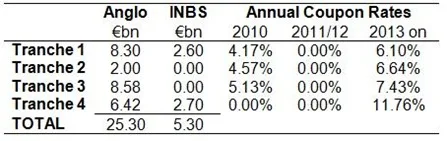
Here are the four tranches of the Promissory Notes:

The 2010 column gives the annual coupon on the notes.   The interest rate was set using an equivalent Irish government bond at the time the tranche was issued.  The first three tranches were issued in the first half of 2010.  Tranche 4 was issued on the 31st December 2010, by which time Ireland had seen bond yields soar and entered an EU/IMF programme.  The annual coupon of the €9.1 billion in Tranche 4 is 8.6%. 

The promissory notes are like an amortising bond in which the interest and some of the capital is repaid each year.  With one-tenth of the capital amount repaid each year the average maturity of the notes is around five years.  The five-year yield as calculated by Bloomberg is currently around 3.9%.  This is nearly five percentage points lower than the coupon on Tranche 4.  What impact does this have on the fair value of the Promissory Notes?

As a simplified comparison, a €100 five-year bond with a coupon of 8.6% that yields 3.9% would have a current value of around €120.  The drop in Irish government bond yields over the past few weeks will do wonders for the aesthetics (rather than the realities) of the IBRC balance sheet.

This is indeed a hollow exercise but things like this probably account for part of the “technical discussions about technical things” we have been hearing about for nearly a year now in relation to rescheduling of the Promissory Notes.  Here is a reference from October 2011 and today in Nicosia at the informal Eurogroup meeting Michael Noonan once again referred to “technical talks”.

Maybe when these are finally concluded we will be a little like Joan Burton was in an early Dail debate on the Promissory Notes when she declared “we need a Powerpoint presentation on this.”

Sunday, April 1, 2012

The ‘New’ Bond

The  €3.5 billion increase in Ireland’s government bonds as a result of the Promissory Note transactions announced last Thursday can be seen here.

Outstanding Bonds 30-03-12

The change is in the March 2025 bond which now has €11.7 billion in issue rather than €8.3 billion on the last occasion we looked at the Daily Outstanding Bonds Report.

The total amount of bonds in issue has increased to €83.1 billion and when/if the Bank of Ireland component of the announced transactions is put into place, the covered banks will be holding around €16 billion (one-fifth) of these.

Friday, March 30, 2012

Much ado about nothing

With a lot of hope and more than a little expectation, at 4pm yesterday the Minister for Finance made a statement to the Dail on the €3.1 billion payment to be made this weekend on the Promissory Notes to the Irish Bank Resolution Corporation (IBRC).  It turned out to be a bit of a damp squib.

The key issue in this whole sorry saga is the rate at which the Exceptional Liquidity Assistance provided by the Central Bank of Ireland to the IBRC is repaid.  The 2011 Annual Report from the IBRC shows that this stood at €42.2 billion at the end of December.  This money was ‘printed’ by the Central Bank of Ireland and given to the IBRC, and it now needs to be returned by the IBRC so the Central Bank can ‘burn’ it.  Nearly three-quarters of the money to meet this requirement will come via the Promissory Notes.

It is hard to see any change at all.  The IBRC needed to get €3.1 billion of cash this weekend;  the IBRC is getting it.  The IBRC needed this money to give to the Central Bank; the Central Bank is getting it; the Central Bank will burn it.  A statement from an ECB spokesperson makes clear that they don’t see any change either.

“It is very important that the Irish state will honour the 3.06 billion euro amortisation of the promissory notes. This will reduce the emergency liquidity assistance which IBRC receives from the central bank of Ireland and thus the Eurosystem.

We certainly expect that also in the future the promissory notes will be served according to the schedule to which the government has committed itself.

As Ireland strives to regain market confidence, it is of utmost importance that the commitments of the Irish state are met in line with standing contracts and agreements.”

The Governor of the Central Bank, Patrick Honohan appeared before the Oireachtas Joint Committee on Finance last Tuesday.  The transcript is here.  In response to a question from T.D. Stephen Donnelly he said

Professor Patrick Honohan: “The question I noted in particular related to how much cash IBRC needs. In fact, the objective of the plan is to eliminate the cash need by postponing it.”

This would seem to suggest the plan was to defer the cash payment.  That could be the cash payment into the IBRC or the cash payment from the government.  The first is significant and the suggestion it that this was the “objective of the plan”.  Reducing the cash needs of the IBRC can only come about through a reduction in the cash it needs to repay its ELA obligations.  This is not how things have panned out.

The €3.1 billion cash payment to the IBRC will be made but there has been a slight change in how this payment is being funded. Instead of coming from the current funding arrangements of the State (the EU/IMF loans) it will come from a 'new' government bond.  

As a result of this there has been an increase in funding of €3.1 billion. This appears to be only for 12 months which is of little benefit given that we have funding in place for the next 21 months.   In the Minister’s statement it says:

Ultimately, it is intended that this long term Government bond will be financed for one year, on commercial terms, with Bank of Ireland who may in turn refinance the bond with the ECB.

Ultimately means “in the end; at last; finally”.  There is nothing after “ultimately”.  One year is not long term.  There has been mention of a bond maturing in 2025 but this was not included in the Minister’s statement yesterday, in his statement last Wednesday, nor by Governor Honohan this Tuesday.  I cannot find a primary source for the claim that a 2025 bond would be used but it did enter the public domain somehow. 

If the arrangement ends after one year as the Minister’s statement indicates the impact on the January 2014 funding cliff is negligible (possibly even slightly negative).   As it stands, this time next year we will need to make the next €3.1 billion payment on the Promissory Notes and also a repayment on the bond issued to Bank of Ireland.  This is clear in the statement from Bank of Ireland.

Under the terms of the Repo, IBRC will have an obligation to repurchase the Bonds from the Bank for approximately €3.06bn in cash not later than 364 days after the effective date.

Where is the IBRC going to get €3.1 billion in 12 months time?  There may be some attempt  to further extend the actual repayment of this bond but no solid information on this has been provided. There is no indication who might replace the Bank of Ireland if the arrangement was to be extended.  As it stands in 12 months time the Bank of Ireland will give this bond back to the IBRC and the IBRC must find €3.1 billion to pay for it.

If the actual cash payment can be further delayed there would be a funding gain into 2014 and, according to Governor Honohan, a minor improvement in debt sustainability.

Professor Patrick Honohan:  “In the discussion, the use of a long-term bond has already been mentioned. This is a major step forward from a sustainability perspective. The idea of a long-term bond being used in lieu of a cash payment is a very considerable step forward, considering it puts off for a long number of years the actual need to refinance those payments. In addition, the net cost of this - we can speak about complications later - will be quite low relative to alternative sources of finance. There is a very definite gain in debt sustainability. We are only talking about a fraction of the total promissory notes so we cannot say it is a decisive change, but relative to this amount, it is a considerable improvement.”

I don’t think yesterday’s move sits well with this analysis.  To sum: instead of making with the Promissory Note payment with money borrowed from the EU/IMF at 3.5% to be rolled-over over the next three to ten years, we made the Promissory Note payment with money borrowed from the Bank of Ireland at 5.4% to be rolled over next year.

Printfriendly