Showing posts with label Bank Liabilities. Show all posts

Friday, June 26, 2015

The State of the PCAR Banks

The three banks in which the State continues to hold a stake are AIB, BOI and PTSB (collectively the PCAR banks).  Here is a summary of their aggregate balance sheet position for the past five years.

PCAR Balance Sheet

The main changes are pretty clear.  Their aggregate balance sheets have declined by just over €100 billion since the end of 2010.  On the asset side this has mainly been achieved by a reduction is loans due (repayments, write-offs, NAMA transfers and other sales).  The big move on the liability side has been a reduction of €80 billion in the amount owed to the Eurosystem.  Customer deposits are up around €15 billion while debt liabilities are down around €30 billion.

Net equity in the banks is currently around €23 billion with a combined CT1 ratio of 14.5%.  The loan-to-deposit ratio has fallen from 192 per cent to 123 per cent.

Here is their aggregate income statement for the past five years.

PCAR Income Statement

As has been widely reported the banks “returned to profitability” in 2014 (well AIB and BOI did at any rate).  The €1.6 billion positive net income was mainly driven by provisioning behaviour which declined from €4.5 billion in 2013 to just €0.3 billion in 2014 with the banks writing back provisions in relation to some elements of their loan books.

Selling banks with €22.6 billion of net equity and €1.6 billion of net income in their most recent year should generate substantial funds but the amounts will be unclear as long as the problem of dealing with non-performing loans (€45.7 billion or 23.3 per cent of gross loans) remains.

Wednesday, May 14, 2014

European Spring: Right villain, wrong reason

Philippe Legrain’s recent book, European Spring, has generated a good deal of reaction in Ireland.  Although it is a very broad-ranging book, and a recommended read, the focus in Ireland has been very narrow and mainly has been on the following passage:

For example, had Irish banks defaulted on all their debt at the end of September 2010, German banks would have lost €42.5 billion, British ones, €27.5 billion and French ones €12.3 billion.131

When Ireland was forced to seek a loan from EU and the IMF in November 2010132, the Irish government sought to backtrack on its foolish promise, made in the heat of the post-Lehman panic in October 2008, to guarantee all Irish banks’ debts.  Had it succeeded, the doom loop would have been greatly weakened.  Instead eurozone policymakers, notably ECB President Trichet, outrageously blackmailed the Irish government into making good on its guarantee, by threatening to cut off liquidity to the Irish banking system – in effect, threatening to force it out of the euro.  Thus, having exhausted the borrowing capacity of the Irish government, the creditors of Irish banks could now call on loans from other eurozone governments, along with Britain’s, Sweden’s and the IMF.  This was a flagrant abuse of power by an unelected central banker whose primary duty ought to have been to the citizens of countries that use the euro – not least Irish ones.  Bleeding dry Irish taxpayers to repay foreign debts incurred by Irish banks to finance the country’s property bubble was not only shocking unjust.  It was a devilish mechanism not for the safeguarding financial stability in the eurozone – which would be the ECB’s defence for its actions – but rather for amplifying instability.  It entrenched governments’ backstopping of bank debts, sparking fears about countries that had experienced an Irish-style bank-financed property bubble, notably Spain.  And it threatened to drag even countries with a reasonably sound banking system, such as Italy, into the doom loop if the situation deteriorated.

The sentiments expressed in the second paragraph here are not in serious dispute.  It was the case that the Irish government, through then Minister for Finance Brian Lenihan, did ”raise the issue” of  a “dishonouring of senior debt”.

It was then the case that haircuts to senior bank bondholders were ruled out and the ECB had a key role in this though the detail behind the decision are unclear.  In the clip above Brian Lenihan indicates that the ECB’s refusal to contemplate haircuts to senior bondholders (presumably only in Anglo and Irish Nationwide) was “unanimous”.

In an interview with The Irish Times in January of this year Jens Weidmann said of the time:

Jens Weidmann:  The Governing Council then was weighing bail-in versus financial stability risks, and its majority concluded that the latter were more relevant under the concrete circumstances. In that debate the Bundesbank has always considered it important to make investors bear the risks of their investment decisions and already then favoured contributions of investors in the event of solvency problems, especially for banks that are to be wound down. Our common goal is to be able in the future to wind down banks without endangering financial stability.

But a view opposing such haircuts was previously put forward by Jörg Asmussen in a speech delivered in Dublin in April 2012:

Jörg Asmussen: I know that the decisions concerning the repayment of bondholders in the former Anglo Irish Bank have been a source of controversy. Decisions taken by the Irish authorities such as these are not taken lightly. And the consequences of subsequent actions are weighed carefully. It is true that the ECB viewed it as the least damaging course to fully honour the outstanding senior debts of Anglo. However unpopular that may now seem, this assessment was made at a time of extraordinary stresses in financial markets and great uncertainty. Protecting the hard-won gains and credibility from the early successes in 2011 was also a key consideration, to ensure no negative effects spilled-over to other Irish banks or to banks in other European Countries.

It should be noted that Weidmann did not work for the Bundesbank or Asmussen for the ECB at the time these decisions were made in November 2010 so these are views that were subsequently relayed to them.  It is also worth noting that Legrain became an advisor to Barroso in February 2011 so he too was not involved when these discussions took place.

Regardless, it is now clear that the prospect of enforcing losses on senior bondholders in Anglo and Irish Nationwide was ruled out, in large part, at the insistence of the ECB.  But it is hard to see how this decision was made to save German, French or UK banks.  The decision was made to save the skin/face of the ECB.

In November 2010, the amount of senior bonds remaining in Anglo and Irish Nationwide was around €6 billion.  This is a very significant sum in Irish terms but relatively minor in the overall scheme of the European banking system.   A 66 per cent haircut on these would have been €4 billion of losses which would be little more than a ripple in the pool of European bank losses (even assuming such banks held all of them). 

The impact of the undertaking the action on capital and interbank money markets might have been a consideration but those markets broke down anyway.  Little was gained from refusing Lenihan’s request to impose losses on the €6 billion of Anglo/INBS senior bonds.

By November 2010, private banks had relatively little to lose from the bust Irish banks as a result of the repayments made during and, most significantly at the end, of the two-year guarantee introduced in September 2008.  But one institution did stand to lose heavily if the Irish banks collapsed (or if Ireland withdrew from the euro).  That was the institution that provided the money for these repayments to be made – the European Central Bank.

When the guarantee ended the reliance of the ‘covered’ Irish banks on central bank liquidity shot up.  By November the six banks were accessing €88 billion of liquidity from the ECB and also around €42 billion of ELA from the Central Bank of Ireland.

Central Bank Funding

The ECB did not bounce Ireland into a bailout to rescue German banks; it did so to ensure it would not be burned itself.   Central bank funding of the ‘covered’ banks was €130 billion in November 2010 and it peaked at around €150 billion in February 2011.  These are massive figures in all contexts. 

The ECB wanted to tie Ireland into a programme to ensure this was repaid.  And they were successful.  ECB funding to the remaining covered banks is now down to €23.5 billion while the use of ELA all but ended with the liquidation of the IBRC last February.  Reliance on central bank funding by the covered banks has been reduced by 80 per cent.

The first paragraph above extracted from Legrain’s book has some large numbers for potential losses to German, French and UK banks if the Irish banks defaulted in November 2010.  These numbers are meaningless in the context of the Irish banking collapse.  Footnote 131 tells us where they come from:

131 Bank of International Settlements Quarterly Review, March 2011.  Foreign exposures to Greece, Ireland, Portugal and Spain, by bank nationality, end-Q3 2010, converted from US dollars to euros at exchange rate on 30 September 2010 of €1 = $1.3615.

The BIS report referenced can be accessed here with the accompanying statistical annex here.  The figures used by Legrain are from Table 1 on page 15 of the report with panel below showing the figures for claims on Ireland with the German, French and UK bank claims on banks in Ireland circled.
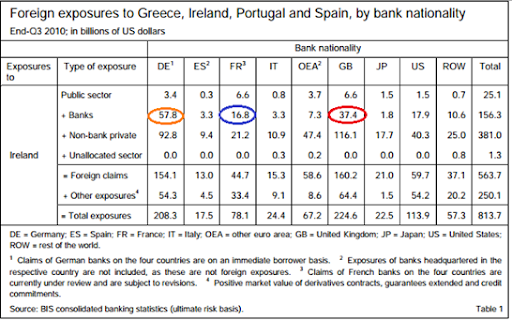
BIS Q3 2010 Ireland

For some reason these figures for Q3 2010 are not the online BIS database. The total liabilities of French, German and UK banks to Ireland are available for Q3 2010 but in  it is not until Q4 2014 that a breakdown by sector (bank, non-bank private and public) is available from the database.

The table below shows the claims for German-, French- and UK- headquartered banks on Ireland (banks, public sector, non-bank private sector and total) for all quarters in 2010 and 2011 and the sectoral breakdown where available from the database. Click to enlarge.

BIS Claims on Ireland Data

The first quarter for which the sectoral breakdown is provided in the BIS database is Q4 2010 and the data shows that at that time the amounts owed by banks in Ireland to German-, French- and UK-headquartered banks were $28.5 billion, $8.1 billion and $18.3 billion respectively.  These are somewhat distant from the $57.8 billion, $16.8 billion and $37.4 billion figures for the previous quarter shown in the Q3 2010 BIS report.  This is not surprising and the reason for the rapid decline is the bank run that happened in Ireland in late 2010.

The figures are precisely true for what they represent: claims of foreign banks on banks in Ireland.  The figures are precisely useless for what they are most frequently used to represent: losses avoided by foreign banks from the rescue of the six ‘covered’ banks in Ireland.

One reason is that saying “German banks would have lost €42.5 billion, British ones, €27.5 billion and French ones €12.3 billion” requires there to have been a 100 per cent default which is patently unrealistic.  However, the main reason for the inappropriateness of the figures in trying measure potential bank losses that were avoided by the bank bailout is that there was far more than six banks operating in Ireland in late 2010. 

The Irish government rescued AIB, Anglo, BOI, EBS, INBS and PTSB.  The €64 billion comes from their rescue.  Included in the above BIS figures are also Ulster Bank, Bank of Scotland (Ireland), Danske, KBS, Rabobank and other foreign-owned retail banks operating in Ireland.

Most importantly though the above figures include the liabilities of banks operating in the IFSC which have close to nothing to do with the domestic Irish economy (apart from providing employment and paying some taxes) and equally nothing to do with the collapse and bailout of the Irish banking system.

A look at the post on the Irish bank run shows that an almost equal amount of deposits were leaving ‘Other Banks’ (i.e. IFSC banks) and all the ‘Domestic Banks’.  In fact, in the last six months of 2010 deposits in banks operating in Ireland fell by €200 billion; the reduction for the covered banks (a sub-group of the ‘Domestic Banks’) was €75 billion.  Most of the deposit flight from Irish banks was in those banks not bailed out by the Irish government. 

Total Deposits by Banks

The deposit flight can be seen in the reduction in foreign bank claims on the Irish banking sector in the above table from $148 billion and the end of Q2 2010 to $83 billion at the end of Q4 2010.  It is clear it is more than just foreign banks who withdrew deposits from banks operating in Ireland – again with most of that from the non-covered banks.

Whatever the BIS data can tell us, and it is useful in some contexts, it can tell us very little about the exposure of foreign banks to the six bailed-out banks in Ireland.  As shown in the table most of the foreign-bank exposure to Ireland is to the non-bank private sector which is likely to be collective investment funds based in the IFSC.

Do we have any insight on the foreign funding used by the six ‘covered’ banks?  Yes, from this research note from the Central Bank of Ireland which looked at the foreign-funding of “Irish-headquartered banks”.  By and large these were the six covered banks (AIB, ANGLO, BOI, EBS, INBS and PTSB) but did also include some banks active in the covered bank market (Pfandbrief banks) who had their headquarters in Ireland from 2002 to 2011.

The funding of Irish-headquartered banks is usefully summarised in this chart.

Foreign Funding of Irish Banks

The conclusion is pretty straightforward:

Throughout the 2000s the UK remained the predominant source of foreign funding for the Irish banking system, representing 77 per cent of foreign funding by mid-2008.  After the UK, creditors in the US and offshore centres accounted for the most substantial shares of foreign funding at 13 and 5 per cent, respectively by mid-2008

Germany was the source of approximately 11 billion or 25 per cent of total foreign funding at end-2002.  Thereafter, absolute German funding fell quite quickly to below 5 billion, or 5 per cent, by end-2006 and to below 1 billion or 1 per cent by end-2007. Pfandbrief banks headquartered in Ireland accounted for nearly eighty per cent of this funding.

The relative unimportance of other euro area countries as a source of the Irish banking system’s foreign funding is surprising.

And the chart is done on a residence basis.  If Irish banks got funding from affiliates abroad it would be included in the above chart.  Most of the covered banks had operations, of varying sizes, in the UK.  So if AIB-UK provided funding to AIB in Ireland it is counted as UK-sourced funding in the above chart. 

It can be seen in the chart below that almost all of the increase in the foreign funding of Irish banks was from banks (the red line) with most of this from non-affiliates (the blue line) than from affiliates (the purple line).

Sectoral Profile of Foreign Funding

It can be seen that at the end of bank guarantee funding from non-affiliated foreign banks collapsed from around €55 billion to around €5 billion.  This was offset by an equally sharp but temporary increase in funding from foreign-affiliated banks.  By the time of the bailout (the middle of the dashed lines) the amount of funding owed by Irish-headquartered banks to foreign banks was very very small.

Of course, the above data doesn’t allow us to pierce through and see where the affiliated foreign banks were getting the funding they were providing to their Irish parents. 

All this really shows is that in November 2010 German, French and UK banks were not in hock to the failed Irish banks.  The Irish banks did get funding by the UK interbank market but that ended with the guarantee a couple of months previously.  At no time did the Irish banks access significant funding from German or French banks.

The ECB did not force Ireland into a bailout and require the repayment of senior bond in Anglo and INBS to save German and French banks; it was done to save the ECB itself which was owed €150 billion by the Irish banks and was trying, and failing, to keep the European banking system fluid.  The ECB was ensuring that it got its €150 billion euro back and was trying to save face because as a central bank it can’t go bust.

Philippe Legrain is right to point out that ECB forced Ireland into costly actions such as the repayment of €6 billion of senior unsecured (and by that time unguaranteed) bonds in Anglo and INBS.  He is wrong to say it was to save German and French banks.  By November 2010, foreign funding from non-banks (c. €25 billion) was much larger than from foreign non-affiliate banks (c. €5 billion) and foreign affiliate bank funding was largest of all.  It is likely that most of the €6 billion repaid on those bonds went to non-banks.

Why did the ECB bounce Ireland into a bailout?  It wasn’t to rescue German and French banks.  It was probably to ensure that Ireland did not have the time to make provisions to put an alternative currency in place.  We don’t know if the government had a Plan B in place in November 2010, and even if there it it is likely to have been something that had close to zero chance of actually happening, but the ECB wasn’t going to give them the opportunity to think about it. 

Tuesday, April 8, 2014

Just what was guaranteed and who was bailed out?

We are all aware that the decision of September 30th 2008 resulted in a the creation of a contingent liability of around €440 billion for the State but details about this total have been scant. 

We know that €75 billion was a result of the Deposit Guarantee Scheme, the limits of which has been substantially increased just over a week previously and this chart from page 77 of the Nyberg Report provided an overall breakdown of the €375 billion of liabilities covered by the near-blanket guarantee.

Guaranteed Liabilities

Via an FOI request by TD Stephen Donnelly, new figures (well new to me anyway) giving the breakdown of these liabilities by institution have now been released.  This may be raking over old ground but here are the figures. Click to enlarge.

Guaranteed Liabilities by Institution

There are no hot embers and the figures are much as would be expected from looking at the annual reports of the banks issued for this period (though only Anglo had a year-end at the time that coincided with end-September 2008).

The figures of central interest are undoubtedly those for Anglo and INBS.  These are the institutions which, in retrospect, should not have been saved.  All told, the State provided €34.7 billion of capital injections to shore up these delinquent institutions.  Most of this money went to depositors.

Between them Anglo and INBS had €77.4 billion covered by the guarantee.  Of this, €2.4 billion was date subordinated debt none of which matured during the two years of the guarantee and was subsequently subject to haircuts of between 50 and 70 per cent.  That leaves €75.0 billion of liabilities to meet the €34.7 billion of losses covered by the State’s capital injections.  For simplicity we will combine the two banks as one, which of course did subsequently happen.

If this could have been known at the time, or some immediate way was found to freeze these liabilities until the total loss was known then a haircut of 39 per cent would have been required.  If a fixed 39 per cent haircut was applied across the board then the following losses would have resulted.

Anglo-INBS Rescue

If put into resolution, the customer deposits up to €100,000 protected by the Deposit Guarantee Scheme (DGS) would need to be made good and the DGS would then take the place of the depositors but as an unsecured creditor of the bank.  That is why the DGS appears in the above table of estimated losses and means the €34.7 billion would be spread across most of the banks’ creditors.  [If the DGS deposits were paid from the assets of the bank the required haircut on the other creditors would rise to 46 per cent to give the €34.7 billion of savings. But that is not how it would work.]

Even if the bank was put into immediate resolution the DGS scheme would have had to meet a loss of around €5.2 billion and presumably this would have come from public resources.  Of course there is also the question of where €13.2 billion would have come from to make good the covered deposits up front.  It was going to be the “cheapest bailout in the world”.

After the losses that have remained to be absorbed by the State (via the DGS) we can see that depositors outside the DGS were sheltered from around €20 billion of losses through the guarantee and senior unsecured bonds from around €9 billion.  This assumes that the same fixed haircut is applied to all creditors and that the resolution wasn’t botched to the same extent that the Cypriot case was four years later. 

Haircuts to depositors would have been a very remote possibility in September 2008.  If the resolution option was taken it is likely that all deposits would have been made good in the manner of the DGS-backed deposits with the State taking their place as an unsecured creditor. 

To cover all the deposits in Anglo and INBS this would have required finding €63.8 billion up front with the State only getting €38.7 billion of this back if the resolution resulted in the same level of losses that have been provided for to date.  A deposit rescue of Anglo and INBS would have cost the State €25.1 billion.

Simplifying assumptions aside this shows that, by amount, the big winners from the decision to guarantee Anglo and INBS were depositors, not bondholders.  Bondholders did dodge something around €9 billion of losses through the failure to put Anglo and INBS into resolution around the time it became known they were insolvent.  €9 billion is a massive amount of money.

Monday, October 7, 2013

Alternatives to the Guarantee – again!

An article by Donal Donovan in last Saturday’s Irish Times reiterates a point made previously that the almost-blanket two-year guarantee introduced for the six Irish banks in September 2008 was the “least-worst option”.

Careful examination of all the possibilities available at the time leads one to conclude, as did the Honohan and Nyberg reports (and my recent book jointly authored with Antoin Murphy), that some form of comprehensive guarantee could not have been avoided – it was the least worst alternative.

I think a careful reading of the Honohan and Nyberg reports is that once all other alternatives had been eliminated the only remaining option was a comprehensive guarantee.  Much of their respective discussions focus on the reasoning, or lack thereof, that led to the exclusion of possible alternatives.

What were the alternatives?  We previously looked at some of these around the time of the first ‘Anglo Tapes’.  Combining the reports of Honohan and Nyberg with the note from Merrill Lynch given to the government on the night of the guarantee provides the following list:

  • Guarantee of all existing liabilities (blanket)
  • Guarantee of some existing liabilities (partial)
  • Guarantee of new liabilities
  • Put failed banks into resolution/liquidation
  • Consolidation of banks through mergers
  • Nationalisation of distressed banks
  • Put distressed banks into protective custody through preference shares
  • Split distressed banks into good banks/bad banks
  • Offer immediate liquidity through a Secured Lending Scheme (SLS)
  • Offer immediate liquidity through Emergency Liquidity Assistance (ELA)

Some consideration was given to most of these but the latter nine were eliminated for one reason or another.  The Merrill Lynch report at the time and the Honohan and Nyberg reports in retrospect all favoured the immediate provision of liquidity to the banks who needed it. Merrill Lynch began the conclusion of their report with:

The extension of a discreet liquidity advance is important to stabilise Anglo [and possibly INBS] and avoid contagion risk.

However, it was decided that liquidity would not be provided from either the assets of the NTMA or the money-creating facilities at the Central Bank of Ireland.  Here is Nyberg on this decision (paragraph 4.7.8):

The policy decision not to use such alternative funding seems to have been based on judgment rather than on an externally imposed limitation. Had the authorities or the Government wished to avoid immediately providing a broad guarantee, some of these funding options were available though, perhaps, not easily. Buying time, even until following week-end, would not have been an idle exercise. It would have allowed the authorities the opportunity to assess more extensively the advantages and disadvantages of the alternative approaches available.  The issue of urgently scrutinising and possibly nationalising certain banks could have been considered, including the option of splitting off their bad assets into variously managed nonbank vehicles (for which funding would have had to be found). There would perhaps have been some scope for discussing and streamlining policy alternatives more intensively with euro area partners. In the best case scenario, there could have been sufficient time to allow for the emergence of an initial common EU approach to the crisis. High priority could even have been given to urgently pursuing legislation covering a special resolution regime, thereby expanding the options available for addressing the fallout from a potentially insolvent financial institution.

And similarly Honohan (paragraph 8.51):

In addition to influencing financial stability policy, a key role of the Central Bank in a crisis is to ensure adequate provision of liquidity. It was prepared on the night of 29/30 September to extend a modest amount of ELA, but not enough to ensure that Anglo would get through the week. Thus back-up liquidity provision was instead hastily secured from the two largest commercial banks, and, crucially, backed by Government guarantee. In effect, the commercial banks were stepping in to provide the lender of last resort facility – which of course was in their own interest to do. The reluctance to deploy more significant ELA facilities from the Central Bank is open to question: such facilities were being used elsewhere and too much was likely made of the reputational risks involved (especially given that the guarantee was about to be announced). It is unlikely that even extensive use of the facility to buy time to facilitate nationalisation the following weekend would have been viewed negatively by partner central banks under the circumstances. While use of ELA would only have been a temporary solution, it might have bought some breathing space while other possibilities were being explored to address the unprecedented situation that many – not only in Ireland – were facing.

So the decision not to provide immediate liquidity was a “judgement” that was “open to question”.  Not exactly ringing endorsements of the path actually taken.  It was the refusal to provide liquidity that made a guarantee all but inevitable.  And as was discussed in the previous post Anglo did not look for the guarantee in September 2008; they just wanted liquidity to keep the doors open.

Of course, it is possible that providing liquidity would have made little difference to the final outcome but it should not be viewed through a lens of “there was no alternative”.  Both Honohan and Nyberg allude to “buying time” or “breathing space”. 

Although reference is made to possible solutions at EU level it is clear that none was envisaged by the government on the night the guarantee decision was made.  In fact, in a Seanad debate on the emergency legislation for the guarantee that took place on the Wednesday morning, Minister for Finance, Brian Lenihan said:

As far as Europe is concerned, and I am a strong European who is proud of our participation in the euro, we were on our own last Monday evening. People are complaining that only six institutions are covered by the proposed measure. The six institutions in question would have been orphans in the world if the sovereign Irish State had not supported them last Monday evening. All the other institutions which want recognition have other sovereigns behind them, some of which are much bigger and more powerful than this State. We had six institutions which had no one to turn to but the sovereign Irish State.

The timestamp on the transcript shows that this was said just before 5am.  But a lack of European support on the night in question is not sufficient to justify the two-year guarantee enacted.  It was too late in Ireland’s case as policy here became locked in because of the guarantee but the European response did come just 12 days later at an EU summit in Brussels.  At this summit it was decided, among other things, that the central banks would provide liquidity to banks that needed it.

Ensuring appropriate liquidity conditions for financial institutions.

6) We welcome the recent decision by the European Central Bank and other Central Banks in the world to cut their interest rates.

7) We also welcome the decisions by the European Central Bank to improve the conditions for the refinancing of banks and to provide more longer term funding. We look forward to Central Banks considering all ways and means to react flexibly to the current market environment.

We welcome the intention of the ECB and the Eurosystem to react flexibly to the current market environment, in particular in considering to further improve its collateral framework with regard to the eligibility of commercial paper.

So if banks needed liquidity the ECB was prepared to relax its collateral rules and provide the liquidity through the ECB’s refinancing operations.  If that failed, ELA through the national central bank remained an option.  Although it happened much later, the case of the Cypriot banks has shown that the ECB will make liquidity available in almost all circumstances.

It must be remembered though that regardless of what was done the dye was set by the end of September 2008.  The banks were bust and there was nothing that could have been done to prevent a hugely expensive banking crisis.  However, any possible incremental cost of the guarantee should not be discounted because it is small relative to the overall fiscal cost of the banking crisis. 

If the two-year near-blanket guarantee had not been implemented how much would have been saved?  That is an impossible question to answer as it is not a case of reducing costs but of redistributing them, and different courses of action may result in higher or lower overall costs to be distributed. 

So far the State has provided €64 billion to our delinquent banks.  The rescue, and associated costs, of AIB, BOI, EBS and PTSB were always going to be undertaken.  The question is the rescue of Anglo and INBS which has an estimated cost of €35 billion.  Patrick Honohan is clear that this should not have happened (albeit under the proviso of knowing what we know now) in  footnote 18 of this speech.

It would have been better had Anglo and INBS been put into resolution as soon as it became clear that their capital was going to be wiped-out by unavoidable losses on developer loans. This should have been evident before September 2008, but was not, leading the Government of the day to include these two failed entities in its blanket guarantee.

Was it clear to anyone that Anglo and INBS were going to have their capital wiped out?  Morgan Kelly said so in public and someone in the Department of Finance thought so in private.  At a meeting that took place “about” the 25th September the then Secretary-General of the Department of Finance, David Doyle is recorded as noting:

“that Government would need a good idea of the potential loss exposures within Anglo and INBS - on some assumptions INBS could be €2 billion after capital and Anglo could be €8.5 billion.”

The ‘Anglo Tapes’ have also shown that Merrill Lynch were in favour of some form of shut-down of Anglo.  This was said by Anglo CEO, David Drumm on the 15th of December 2008:

“It’s Merrill’s. And according to, erm, Alan Dukes today, the government ignored Merrill's advice and didn't shut us.  You know, they wanted us nationalised. 'Just take them off the field, they're a basket case.' And ignored the advice and said: 'No. We want, we want to see if we can get the banks through this.”

It is not clear when or how this advice was given or if the proposal would have resulted in any reduction of the fiscal cost of the Anglo bailout.  The point is merely to show that the solvency of the banks was been discussed and that they were some participants who were of the view that Anglo was beyond redemption.  Of course, this was also the time that David Drumm was talking of a bond buyback in Anglo that he said would generate €9 billion in savings.  It not clear how this would work or how it would fit in with the guarantee.

Merrill Lynch might have advised that Anglo was a “basket case” before December 2008 but two months later PwC presented a report to the Department of Finance which concluded that Anglo was sound and would continue to remain so:

“Under the PwC highest stress scenario, Anglo’s core equity and tier 1 ratios are projected to exceed regulatory minima (Tier 1 – 4%) at 30 September 2010 after taking account of operating profits and stressed impairments.”

It seems to have been a case that advice to cover all viewpoints was available and it was simply a matter of picking the one that best fitted the narrative one was trying to sell or the one that tied in with a policy that had become locked in.

The September 2008 guarantee did increase the fiscal cost of the banking crisis.  On this the Honohan report (paragraph 8.39) says :

The scope of the Irish guarantee was exceptionally broad. Not only did it cover all deposits, including corporate and even interbank deposits, as well as certain asset-backed bonds (―covered bonds‖) and senior debt it also included, as noted already, certain subordinated debt. The inclusion of existing long-term bonds and some subordinated debt (which, as part of the capital structure of a bank is intended to act as a buffer against losses) was not necessary in order to protect the immediate liquidity position. These investments were in effect locked-in. Their inclusion complicated eventual loss allocation and resolution options

With paragraph 8.50 going further on the issue of subordinated debt:

The inclusion of subordinated debt in the guarantee is not easy to defend against criticism. The arguments that were made in favour of this coverage seem weak: And it lacked precedents in other countries (although subordinated debt holders of some other banks since rescued abroad have in effect been made whole by the rescue method employed). Inclusion of this debt limited the range of loss-sharing resolution options in subsequent months, and likely increased the potential share of the total losses borne by the State.

Although it should be pointed of the €12.2 billion of dated subordinated debt covered by the guarantee only €1.4 billion matured during the period of the guarantee, none of which was in Anglo.  The cost of including subordinated debt in the guarantee was, in the broad scheme of things, relatively small.

By September 2008, a banking crisis with massive costs was inevitable.  The guarantee worked in one sense (kept the banking system open) and failed in another (limited ultimate loss allocation after equity to the State).  Could the final fiscal have been lower under an alternative to the guarantee?  Possibly.  The issue is not so much the amounts (which are impossible to ascertain) but more that the guarantee decision cannot be discounted because “there was no alternative”.

There were alternatives and getting a better insight into why they were rejected is important both for understanding the past and preparing for the future (both here and elsewhere).  Of course, it is probably more important to understand why the main banks started, and were allowed to continue, chasing Anglo from around 2002 which in the words of one AIB executive had “joined us for breakfast but now they’re eating our lunch”.  There is some talk of a banking inquiry but we appear to be no nearer a concerted effort to find the answers to these questions.

Friday, June 28, 2013

The Anglo tapes and alternatives to the guarantee

Below the fold is a narrative that tries to pull together the revelations in the Anglo tapes this weekend as well as the piecemeal information we already have about the run-up to, and aftermath of, the blanket guarantee introduced in September 2008.  For anyone who has shown even a modicum of interest in these developments there is nothing new that follows but maybe it will help to pull a few threads together on the alternatives that were available and the decisions that were taken.

Monday, April 8, 2013

Recapitalising the Banks

The issue of further capital for the banks has attracted some attention in recent days.  Prof. Brian Lucey had a piece in Saturday’s Irish Examiner and yesterday’s Sunday Business Post led with the headline ‘IMF warns of new €16bn black hole in Irish banks’.

The issue in the SBP piece is actually about the contingent liabilities of the State rather than the banks and the IMF have actually been making the same point for at least a year.  Here is a quote from the IMF’s fifth review issued this time last year with the same 10% of GDP (€16 billion) contingency.

Recognition of contingent liabilities would constitute a one-off increase in the level of debt. Ireland’s contingent fiscal liabilities relate to the covered banks, the IBRC, and NAMA. There is no expectation of losses from these entities as the covered banks have been recapitalized under PCAR 2011, the IBRC meets capital adequacy requirements, and NAMA received assets at heavy discounts—averaging 58 percent—to protect its viability. Under the standard scenario, the assumption of 10 percent of GDP in contingent liabilities by the Irish government would raise the debt-to-GDP ratio to 124 percent in 2012 and cause it to peak at 129 percent in the following year, but starting from 2014 debt would start to decline steadily, reaching 123 percent by 2016. However, the debt trajectory would be higher if the higher debt level resulted in higher interest rates on new market funding.

Although the level and composition of the contingent liabilities have changed over the year (NAMA Bonds, ELG guarantees, ELA Guarantees), and are subject to further change because of the IBRC liquidation, the IMF have not adjusted the 10% of GDP contingency in their scenario analysis.  It is not clear that they have given this issue much consideration recently.

In fact if we go all the way back to the IMF’s first review (May 2011) we find this graph in the annex on public debt sustainability (page 41).

Contingent Liabilities Shock

And even before November 2010, the IMF included a ‘one-time 10% of GDP contingent liabilities shock’ in their debt sustainability analysis.  Check out page 37 of the Article IV Report on Ireland published in June 2009.

So the IMF is not warning of a ‘new €16 billion black hole in the Irish banks’ but the broader question still stands:  will the Irish banks need more capital?  Maybe or maybe not.  When Craig Beaumont, the IMF Mission Chief to Ireland was asked as part of the conference call on the publication of their latest report on Ireland (the ninth review) he was non-committal as can be seen below the fold.

Wednesday, February 6, 2013

“Lots of Debt” in the IBRC?

On last night’s Primetime, Professor Hans-Werner Sinn seemed to support a default on the upcoming €3.1 billion payment on the Anglo Promissory Notes.  From the interview:

PK: If, for example, we decide we are not going to pay the 3.1 billion on the Promissory Note which is due at the end of March.  That means that the former Anglo bank will not have the cash to do what it needs to do – to wind down.  The ECB will say “that’s a default”.

HWS: Why don’t you let it default? Default is the best way to solve such a problem. It doesn’t mean the bank comes to an end; it just means that the creditors have to forgive some of the debt and this is quite natural.  They made the investment decision.

And

HWS: Well there is still lots of debt in the banking sector, including the Anglo Irish Bank, the follow-up bank, the bad bank.  It has bondholders; it has creditors.

PK: So burn them?

HWS: Well, ask them to forgive some of the debt.

“Why not let it default?”  That could be done but it is clear that Professor Sinn does not know what is left in Anglo/INBS, now known as the Irish Bank Resolution Corporation (IBRC).  Here is an abridged version of the IBRC balance for the end of June 2012 taken from its latest interim report (page 24)

IBRC Balance Sheet June 2012

IBRC does have a lot of liabilities but 85% of it is the Exceptional Liquidity Assistance (ELA) it drew down from the Central Bank of Ireland in 2010 to repay the huge amount of deposits that left at that time.  The €3 billion of “Deposits from Other Banks” is the repurchase agreement entered into with Bank of Ireland last year with an Irish government bond that was used to meet last year’s Promissory Note/ELA repayment.  The IBRC must repay this in June.

There is not “lots of debt” to renege on unless Professor Sinn means a default on the ELA that is ultimately owed to the ECB and that we should ask them “to forgive some of the debt”.  However, when pressed further he doesn’t seem to advocate this.

PK: The ECB will allow us to do this?

HWS: I don’t know what the ECB will say.

Friday, January 4, 2013

Why bondholders are not the problem

(but could have been part of the solution)

The issue of bank bondholders continues to garner significant attention with articles such as this which proclaims:

IN THE LAST of over €20 billion in bonds paid out this year by Irish banks, Bank of Ireland has paid out €37.3 million to senior unsecured bondholders today.

It seems there are attempts to put some significance on the amount of bond repayments made by the banks.  For some reason, no significance or detail is provided of deposit redemptions made by the banks.  Both give money to the banks and expect it back at some stage.  Deposits can be withdrawn at any stage or after a short notice period.  The money given for a bond can only be withdrawn from the bank on maturity of the bond. 

The interest earned on a bond will usually be greater than the interest earned on a deposit because of this restriction.  Deposits tend to be non-transferable whereas somebody providing money to a bank via a bond will be issued with a saleable security.  Although, the money for the bond cannot be withdrawn until maturity the holder can choose the sell the bond in the secondary market at the prevailing market price.

Before Christmas, Stephen Donnelly wrote:

Tuesday, September 18, 2012

Who got bailed out in Anglo?

The question of restructuring the Promissory Notes used in 2010 to recapitalise Anglo Irish Bank (€25.3 billion) and Irish Nationwide (€5.3 billion) has been ongoing for more than a year now. [A smaller promissory note of €0.25 billion was also provided to EBS.]

As well as a €25.3 billion of Promissory Notes which were provided in four tranches in 2010, Anglo Irish Bank also received €4 billion of cash from the Exchequer in 2009.  In total €29.3 billion has been committed to the bailout of this bank.

Obviously, the problems emerged on the asset side of the bank and this is an incredible amount of money to have to provide to a bank that, on the night of the guarantee, had about €73 billion of loans to customers outstanding.  This loans have proved to worth only about half that amount.

So who was owed money by Anglo on the night of the guarantee?  Who was in line to face losses given that more than half the value of the loans issued by the bank were not going to be repaid?  Here is an abridged and amended version of the liability side of the Anglo Irish Bank balance sheet as reported for the 30th of September 2008.

Anglo Liabilities

At the time of the guarantee Anglo owed over €100 billion.  The €4 billion of shareholder equity was wiped out pretty much as soon as the bank began to provide for the massive losses on its loan book.  During 2009 and 2010, €3.3 billion of losses were imposed on subordinated creditors of the bank.  After these €7 billion of losses, the first five creditors on the above list were repaid in full.

On the night of the bank guarantee there was just under €11 billion of senior unsecured bonds in issue from Anglo Irish Bank.  Most of the money provided to Anglo Irish Bank did not go to ensure repayments to bondholders could be made; it went to depositors.

Of the €72 billion of deposits in Anglo on the 30th of September 2008, around €19 billion were in customer accounts which comprised “demand, notice and fixed term deposit accounts from personal savers with maturities of up to two years” .  For the €32 billion of non-retail deposits the annual report says:

Non-retail deposits are sourced from commercial entities, charities, public sector bodies, pension funds, credit unions and other non-bank financial institutions. At 30 September 2008 non-retail deposits were more concentrated and shorter in duration than at the prior year end. 

In addition, at 30 September 2008 non-retail deposits included €7.3 billion of deposits from Irish Life Assurance plc, a non-bank affiliate of the Irish Life & Permanent group, which matured on or before 3 October 2008.

Of the €20 billion of deposits from banks, half were on terms that would require them to be repaid in eight days or less.  In fact, of the total deposits held by the bank, around €47 billion had an agreed maturity or notice period of less than one month.  The bailout of Anglo was of deposits from banking and non-banking institutions and also the individual customer accounts of (wealthy) depositors.

Although in line to absorb losses,  the €11 billion of senior unsecured bonds in Anglo on the night of the guarantee did not consume the €29 billion that has been committed to the bank.

Tuesday, September 4, 2012

Tax Revenue Profiles

While the headline is that “tax take is €365 million ahead of target by end of August” it is useful to go behind the numbers a little bit.  The documents from the Department of Finance are:

Tax revenue is clearly €365 million “ahead of profile”.   It was forecast that €21,711 million of tax would be collected by the end of August.  The outturn is €22,076 million.  However, there are a couple of points to note about the profile.

A revised profile was released on May 2nd to account for delayed Corporation Tax receipts from 2011 and the reclassification of some PRSI receipts as Income Tax that affected the first quarter figures..

As we previously pointed out the revised profile starts with a figure of €8,396 million of tax revenue to the end of March when it was known for a month before the profile was released that €8,722 million of tax had actually been collected in the first three months of the year.  It helps to be “ahead of profile” when you use a profile that is more than €300 million below what you already know has happened.

So how have tax revenues fared in the months since the release of the revised profile.  These are department projections for May, June, July and August and how they compare to the actual outturn.

Tax Forecasts for August 2012

Since the effective tax profile was released on the second of May, tax revenue is €21 million behind expectations.  This is only a shortfall of 0.3% but it can be seen that the total figure is being supported by a €143 million boost from Corporation Tax.  The performance of Income Tax and Excise Duty are significantly below expectations.  Here are the monthly comparisons for total tax revenue.

Monthly Tax Forecasts to August 2012By the end of June tax revenue was more than €500 million “ahead of profile” but about a third of that has been given up in the past two months, with August in particular falling well short.  The DoF documents show that Income Tax and Excise Duty account for most of the shortfall.

Monthly Tax Forecasts August 2012

The relatively good performance in the first six months of the year means that this month’s deterioration is unlikely to threaten the budgetary arithmetic and the end-year target of €36.4 billion.  Tax revenue is “ahead of profile” for the year but the performance is not as strong when limited to the period since the profile was actually released.

It is likely that over the coming months there will be more months where tax revenue is “behind profile”.  This could be a function of the projections as much as it is of tax performance.  This is a by-product of moving more than €300 million of taxes from the actual receipts for January to March to the projections for April to December.   By year-end it is probable that receipts will continue to move from the current €365 million ahead of profile closer to the €36.4 billion annual target.

Wednesday, April 4, 2012

First Quarter Exchequer Returns

The Department of Finance have released the end-March Exchequer Returns.  The relevant documents are:

The Department have improved their presentation of the tax receipts data and much of the analysis that was previously provided here is now included in the release.  This is a welcome development.

Another welcome development is the new Department of Finance Databank which gives monthly Exchequer tax receipts back to 1984.  Expenditure figures are provided in the Department of Public Expenditure and Reform Databank which has been available for some time.

On the whole, the results seem slightly positive.  Tax revenue is up on the year but a lot of that is due to delayed receipts from 2011 and some reclassifying issues between Income Tax and PRSI.  Even accounting for these, tax revenue seems to be performing as expected though there is an unusual dichotomy between the performance of VAT (up) and Excise Duty (down).

The Current Account Balance is a useful indicator of the performance of the public finances.  On first glance this would appear to be getting worse.  In the first three months of 2011 there was a Current Budget Deficit of €4,177 million.  So far this year we have accumulated a Current Budget Deficit of €4,918 million.

There are three factors to note before jumping to the conclusion that the Current Deficit is continuing to deteriorate:

  1. The Sinking Fund Contribution of €646 million has already been made for 2012.  In 2011 this transfer of €683 million from the Current to Capital Account did not take place until November.  A year-on-year comparison is unfair on 2012 because it includes a payment that was not made by March of last year.
  2. Last year the debt interest cost for the first quarter of the year was €1,425 million, but €577 million of that was paid from the Capital Services Redemption Account with the remaining €848 million coming from the Exchequer Account.  In 2012 all the debt interest bill of €1,658 million was paid from the Exchequer Account.
  3. This year’s receipts include €231 million of Corporation Tax which should have been collected in 2011 but a delay meant it was instead included in the January 2012 receipts.

To account for these we will subtract the Sinking Fund contribution from the 2012 deficit, add the interest paid from the CSRA to the 2011 deficit and subtract the delayed Corporation Tax receipts that have been added to this year’s revenue..

That means the comparison is between a deficit of €4,754 in 2011 and one of €4,503 million.  So far in 2012, the Current Budget Deficit is about €250 million better than it was at the same time last year.  It is not clear how much of this is down to timing and whether it will be continued into the second quarter, but it is positive that the current budget deficit is smaller (even if it is only marginally so).

Friday, January 20, 2012

Is repaying bondholders still an issue?

Yesterday’s Troika press conference has attracted more attention than usual because of an exchange between journalist and broadcaster, Vincent Browne and Klaus Masuch, head of EU Countries Division at the European Central Bank.   The exchange can be seen here.

Although not named we can only assume that Browne was referring to Anglo Irish Bank.  Anglo’s 2008 Annual Report provides details for the year ended 30th September 2008.  This is also the date of the guarantee so it gives us a good indication of the liabilities that were guaranteed on the same night.

By the end of September 2008, the Anglo balance sheet had ballooned to a massive €100 billion.   On the asset side Anglo had forwarded loans of around €72 billion.  We now know that Anglo made losses of around 50% on this loan book.  We have filled that €30 billion+ gap.

Then comes the issue of where Anglo got the money to make these loans.  The Anglo balance sheets reports €100 billion of liabilities of which over €70 billion were just deposits (€52 billion from ‘customers’, €20 billion from banks).  It also shows that there was about €17 billion of 'Debt Securities' (i.e. bonds) in issue at that time.

A note to the accounts gives a breakdown of this total at the 30th September 2008:

Medium term note programme: €10,622 million
Other debt securities in issue: €6,658 million

The category of 'other debt securities' includes commercial paper and certificates of deposit which are almost analogous to deposits.  There were also some €4 billion of subordinated liabilities but those are not of concern here as most of those were not repaid. [Junior debt holders in the covered banks incurred €15.5 billion of losses across the covered banks.]

Anyway at the end of September 2008 Anglo had €10.6 billion of bonds outstanding.  A breakdown showing the amounts of these that were secured and unsecured is not provided.  These bonds (along with all other liabilities) were guaranteed on September 30 and over the past three and half years many of these have been repaid.  After Monday's payment of €1.25 billion there will be around €3 billion of Anglo bonds left to be repaid.

The issue raised by Browne is the repayment of unsecured bondholders in Anglo after the expiry of the original two-year guarantee in September 2010.  Unfortunately for 2010, Anglo changed its year end to 31st December so we cannot get the exact balance sheet position at the expiry of the original guarantee from the 2010 Annual Report.

By the 31st December 2010 the balance sheet of Anglo had shrunk to €72 billion and the total amount of debt securities outstanding had fallen to €6.9 billion.  All the deposit-like 'other securities' had been redeemed so the €6.9 billion was all bonds.  At this stage the bank was again mainly funded by deposits but these were now almost 80% central bank deposits.

Of the €6.9 billion of bonds we are told that "€3.0bn of medium term notes, all of which are Government guaranteed with maturities of up to five years, were issued during the year."  That means there could only be a maximum of €3.9 billion of bonds which were outside the guarantee.

This was confirmed in March 2011 with this release from the Central Bank.  This showed that on the 31st March 2011 there was €3,147 million of senior unsecured unguaranteed bonds in Anglo on the 18th of February 2011 from a total of €6,255 million of bonds (the other €3 billion being the guaranteed bonds).

It is the re-payment of these €3.1 billion of unsecured bonds that was the subject of yesterday's exchange.  It is hard to know how much could be saved if these bonds weren't repaid but given the 60%-80% haircuts applied to subordinated debt it is likely that a haircut of 40% to 60% would be applied to senior debt.  If we take the mid-point and assume that a 50% haircut could be applied then the State will lose around €1.5 billion by repaying these bonds.

Of course, we don’t have the money to repay these bondholders.  We have borrowed it (or rather we will borrow it) through the Promissory Notes.  Repaying the bonds will not cost us €1.5 billion.  The price is €1.5 billion but the cost will be the annual interest payments made on the borrowing to pay the bonds.  At an interest rate of 5% it would cost €75 million per year to service €1.5 billion of debt.  The true savings of not repaying these bonds is this €75 million per year.

Here is the question and the answer and some subsequent comments from this transcript.

Vincent Browne: “Klaus Masuch, did your taxi driver tell you how the Irish people are bewildered that we are required to pay unguaranteed bondholders billions of euros for debts that the Irish people have no relation to or no bearing with, primarily to bail out or to ensure the solvency of European banks? And if the taxi driver had asked you that question,hat would have been your response? That’s my first question.”

Masuch: “I can understand that this is a difficult decision to be made by the government and there’s no doubt about it but there are different aspects of the problem to be, to be balanced against each other and I can understand that the government came to, came to the view that, all in all, the costs for the, for Irish people, for the, for the stability of the banking system, for the confidence in the banking system of taking a certain action in this respect which you are mentioning could likely have been much bigger than the benefits for the taxpayer which of course would have been there. So the financial sector would have been affected; the confidence of the financial sector would have been negatively affected, and I can understand that there were, that there was a difficult decision but that the decision was taken in this direction.”

Browne: “That, that… Well, that doesn’t address the issue. We are required to pay, in respect of a defunct bank – that has no bearing on the welfare of the Irish people at all – we are required to pay in respect of this defunct bank, billions on unguaranteed bonds in order to ensure the health of European banks. Now how would you explain that situation to the taxi driver that you talked about earlier?”

Masuch: “I think I have addressed the question.”

Browne: “No you haven’t addressed the question because you referred to the viability of the Irish financial institutions. This financial institution I’m talking about is defunct. It’s over. It’s finished. Now, why are the Irish people required, under threat from the ECB, why are the Irish people required to pay billions to unguaranteed bondholders under threat from the ECB?”

In his answer Mausch basically said that it was the government’s view (he never actually have his view) that the benefits of repaying these bonds were greater than the savings that could be made by not repaying them.  We know that the saving could be around €1.5 billion.

It would have been useful if Mausch was pressed further on what he felt these benefits were.  It is still not clear what benefits, if any, did accrue from undertaking to repay these bonds; it certainly wasn’t “stability of the (Irish) financial system”.  There may have been benefits from repaying these bonds and this has been couched in references to veiled threats from the ECB.  Would the ECB “pull the plug” if these €3 billion of bonds aren’t repaid?  Unlikely, but in the greater scheme of things the €1.5 billion in question here is not the key issued.

The key issue is the €25 billion of Promissory Notes given to Anglo (along with €6 billion to Irish Nationwide) to cover the loan losses referred to above.  Most of the money that these Notes allowed Anglo to get from the Central Bank went to repay depositors rather than bondholders. 

This issue is how (or whether) we repay the €28.5 billion of these Notes that are still outstanding.  This money is owed to the Central Bank of Ireland but when the Central Bank gets it, it will just “burn” it.  There is no one waiting for this money to be repaid so the question is why do we have to repay it now.  Prof Karl Whelan is once again excellent on this point in this article in Business and Finance.

This issue was raised at both the Noonan/Howling and Troika press conferences.  You can listen to the responses in this extract.  It seems we can expect some kind of ‘position paper’ to be released before the end of February.  This issue is far more significant than some pre-ordained grandstanding about bond payments.  The bondholders are gone.  The debate must move on.  Maybe the next haranguing of the ECB will press them on this.

Monday, October 3, 2011

Deposits in Irish Banks

The level of deposits in the Irish banking system paints a pretty alarming picture.

Total Deposits

The collapse after the end of the initial “blanket” guarantee has been staggering with total deposits dropping from €894 billion in August 2010 to €579 billion in August 2011.  The lead story from Saturday’s Irish Times was that “Overseas deposits at Irish banks increase significantly”.  The article itself is correct but there is little justification for the headline as can be seen in the following graph.  This issue was pointed out by Prof. Karl Whelan over on irisheconomy.ie

Total Deposits by Origin

It is also important to remember that this is all banks operating in Ireland.  From an Irish perspective the key portion of the Irish banking system is the six banks covered by the State guarantee (of which five have now been nationalised).  Deposits in these banks have fallen from €408 billion to €263 billion in the past year.  The did rise by €1.5 billion in August but that is hardly “significant”.

Total Deposits by Origin in Covered Banks

At best, it can be said that deposits in the covered banks have stabilised, and in particular for non-Irish resident deposits.  The trend for Irish resident deposits in the covered banks remains down.

A short presentation going through 17 slides showing different measures of deposits in the Irish banking system (including central bank deposits) is available below the fold.

Friday, September 9, 2011

Getting money back from Anglo?

On the release of Anglo Irish Bank’s half-year results to the end of June 2011, chief executive Mike Aynsley said the following:

"I would be cautiously confident that we are going to get a better result then we had previously expected," chief executive Mike Aynsley told reporters on Friday.

The nationalised lender expects to have shut down by 2020 and Aynsley said he believed the final capital bill for the bank would come in a range of 25-28 billion euros.

"I think it is going to be towards the end (bottom) of that range," Aynsley said.

This all seems ok but note the focus on the “final capital bill for the bank”.  We have provided €29.3 billion of capital to Anglo; Aynsley reckons they will need €25 to €28 billion (with the hope that it will be closer to €25 billion); so there will be a “capital surplus” to be returned to the State.  Good news? Maybe not if we take a closer look at the “total bill for the bank”.

It would be good news if we were “only” providing €29.3 billion to Anglo.  As it is we will be providing much more.  The outstanding balance on the Promissory Notes earn interest for Anglo which must be paid by the State.  As we saw previously the interest rate on some of these notes is very high.  Here is a table from earlier.

Promissory Notes Interest Rates

The annual interest rate ranges from just over 4% for Tranche 1 to nearly 9% for Tranche 4 when the 2011/12 “interest holiday” is factored in.  The accumulated interest bill over the lifetime of the  Promissory Notes is anticipated by the Department of Finance to be over €13 billion as shown in this Information Note.  We can expect that almost €11 billion of this interest will accrue to Anglo.

This €11 billion is interest income for Anglo and is not capital so is counted as operating income.  Mike Aynsley expects the nationalised Anglo to have an operating loss of €25 to €28 billion in its lifetime.  We can use the June 2011 Income Statement (page 22) to see the huge role of the Promissory Note Interest in determining this loss.  Here is an abbreviated version of the income statement

Anglo Income Statement

Anglo reported a loss of €105 million for the first six months of the year, but the largest single income item for Anglo is the €644 million of interest it received from the State for the Promissory Notes.  Without this inflow Anglo’s losses would be much higher.  If this is true for this six month period, it is also true for the remainder of Anglo’s lifetime.

Mike Aynsley might feel that while nationalised that Anglo will generate a loss of €25 t0 €28 billion and will therefore be in a position to return some of the €29.3 billion capital poured into the bank.  But this loss is only possible because of the €11 billion of interest that the State is providing to Anglo.  

The fact the the State must pay interest to Anglo as a result of putting in capital through the device of a Promissory Note is in contrast to some of the capital injections into the functioning banks which see the banks pay an interest rate to the State.

It is clear that without this Promissory Note interest income Anglo losses would be greater than Aynsley’s assessment and would probably be around the €29.3 billion we have provided or, depending on interest rates, even closer to the €34 billion “worst case scenario” that was suggested at the time the Promissory Notes were provided to Anglo. 

To say there may be a “capital surplus” to be returned to the State is technically true.  To say it is because losses are lower than expected is not. 

UPDATE: Here is a table that summarises a discussion in the comments.  The interest totals used here are just the cumulative totals from the Department of Finance Information Note.  All numbers are in billions of euro.

Anglo-INBS Cost

The €13.1 billion interest is based on the assumption that the Promissory Notes and interest will be repaid on a linear basis of €3.1 billion per year until 2025. The €18.4 billion interest cost on the money used to fund the Promissory Notes is based on an interest rate of 4.7% for the period to 2025.  Both of these assumptions are subject to change.

Thursday, September 1, 2011

Deposits in Irish banks

The pattern of the total deposits in all banks operating in Ireland paints a dramatic picture.  Since August 2010 deposits have fallen from €893 billion to €577 billion.

Total Deposits

The fall has been dramatic but it has not been confined to domestic banks.  Deposits in other banks (mainly those operating in the IFSC) have also fallen and these have little effect on the domestic economy.

Total Deposits by Banks

Deposits in domestic banks have fallen from €524 billion to €349 billion and it can be seen that this has mainly occurred in the six covered banks (AIB, BOI, EBS, PTSB, Anglo, INBS).  While deposits in non-covered domestic banks (Ulster Bank, National Irish Bank, Investec etc.) have fallen, it has not been as pronounced as in the covered banks.

Total Deposits by Covered Banks

The main driven of the fall in deposits in the covered banks has been the withdrawal of deposits from outside the eurozone.  Eurozone deposits have remained low.  Deposits from Irish residents have been trending down but seem to have taken an accelerated drop in July.

Total Deposits by Origin in Covered Banks

After falling dramatically in the six months after the expiry of the original bank guarantee deposits from non-residents in the covered banks have been relatively stable in 2011 and actually increase by €1 billion in July.  We have already examined the reason for the drop in Irish resident deposits in the covered banks.

Irish Resident Deposits in Covered Banks

In July the government moved nearly €20 billion of deposits out of the covered banks and used this money to recapitalise the banks.  Apart from this somewhat artificial movement deposits in the covered banks were unchanged in July (down €0.3 billion).

Printfriendly