Wednesday, October 16, 2013

Why is the projected budget deficit higher?

Back in April the Department of Finance published the 2013 Stability Programme Update.  In it the projected general government deficit for 2014 was 4.4% of GDP.  This assumed a package of adjustments of €3.1 billion in the Budget. 

Yesterday a package of €2.5 billion of expenditure cuts and tax increases was announced but because of measures put in place earlier in the year (mainly the Haddington Road Agreement) the amount of adjustment for 2014 remains at €3.1 billion.  The Economic and Fiscal Outlook (bottom of page 13) says:

Tax and expenditure consolidation measures of €2.5 billion are complemented with additional resources and savings of some €600 million, giving a total adjustment package of €3.1 billion.

So if the level of adjustment is the same why is it that the projections issued with yesterday’s budget are for a 2014 deficit of 4.8% of GDP.  A comparison of the April and October figures may provide some insight into where the deterioration comes from.

Budget Projections

It is pretty clear why the projected deficit is higher: revenue for 2014 is now expected to be around 1% lower compared to what was set out in April.  Total expenditure is virtually unchanged.

Why is the revenue figure down?  It is mainly because of lower than expected receipts from Income Tax, VAT and Excise Duty.  As described in the notes to the table on page 33 of the Economic and Fiscal Outlook the 2013 outturn for these is set to be around €650 million than was projected even as recently as April.  These lower receipts in 2013 then have knock-on implications for the 2014 projections.

The composition of expenditure appears to have changed since the publication of the April figures but that is largely down to reclassification issues on about €1 billion of expenditure on third-level education.  Free fees (€250 million) and the block grant (€350 million) have been shifted from Other Expenditure to Social Payments and Subsidies respectively, while another €300 million to universities previously under Capital Transfers has also been reclassified to Subsidies.

A notable change in the expenditure list is the increase in Compensation of Employees of €665 million.  There doesn’t appear to be a reclassification item that is responsible for this.  There is also a €490 million fall in the figure for GFCF, though the Exchequer Account figures actually shows a slight rise in 2014 estimate for Gross Voted Capital Expenditure (€3,230 million in the SPU to €3,335 million in the Budget).  Again we may be looking at a reclassification issue but it does not appear to specified.

The Exchequer Account projections in April’s SPU and the Budget’s EFO also show that the deterioration is mainly due to a reduction in revenue forecasts.  In April, Exchequer Tax Revenue for 2014 was put at €40,975 million.  Yesterday a figure of €40,040 million was provided which represents a decrease of nearly €1 billion.

Why is revenue lower than expected? Mainly lower growth, and also lower inflation, than expected. A recent post covered this and the figures for nominal GDP at the bottom of the table above illustrate the problem.  Back in April, NGDP for 2014 was expected to be €174.3 billion.  Just six months later and the figure has been revised down to €170.6 billion.

Ireland collects the equivalent of 30% of GDP in tax revenue.  It’s a bit crude, but 30% of a €3.7 billion reduction in NGDP is roughly €1 billion.  And that is pretty much the reduction that has been applied to the forecast of tax revenue.

If it wasn’t for the accounting chicanery from the Promissory Note swap yesterday’s budget would have meant a 2014 deficit of around 5.4% of GDP.  As the previous post concluded, excluding the largely notional Promissory Note gains (see here) “the numbers [.] suggest that more should be done if the fiscal consolidation plan is to remain “on track” not less.”

Yesterday’s Budget had the full €3.1 billion of adjustments (as confirmed by the Economic and Fiscal Outlook) and the deficit is not falling as fast as planned.  Even if the 4.8% of GDP deficit targeted for 2014 is achieved there is still a significant step to be made to get it under the 3% of GDP limit in 2015 as required under the Excessive Deficit Procedure.  The gamble being taken (again!) is that nominal growth will have resumed by then and will carry most of the burden.  Who wants that bet?

Tuesday, October 15, 2013

Moving to stop “stateless” profits

Included among the budget documents is a short release on Ireland’s International Tax Strategy.  There is not a lot new in it but it does signal that the ability of companies such as Apple to create “stateless” profits or “ocean money” will be curtailed.

The second measure to be included in the Finance Bill is a change to our company residence rules aimed at eliminating mismatches - that can exist between tax treaty partners in certain circumstances – being used to allow companies to be ‘stateless’ in terms of their place of tax residence.

This was signalled here yesterday towards the end of a post on corporation tax:

We are probably not going to hear much at this level of detail in tomorrow’s budget but the Finance Act, 2014 may look to disassociate Ireland from the “ocean money” created by Apple.

No improvement for the household sector

Yesterday the CSO published the Q2 2013 Non-Financial Institutional Sector Accounts.  Here we will focus on the household sector and the main aggregates in H1 2012 and H1 2013.

Household Sector H1 2013

A year-on-year comparison does not show any improvement.  Earnings and social benefits received are down while taxes and social contributions paid are up.  All told, gross disposable income in the first half of 2013 was 3% lower than in the first half of 2013. 

Even though income for the half was down, consumption expenditure held up and rose slightly on 2012.  This means that savings (income not used for consumption) were down.  Savings in the first half of 2013 were around €1.5 billion lower than in 2012.  This will be reflected in reduced deposit accumulation, debt repayments and/or capital investment from the household sector.

The gross savings rate, including an adjustment for the net equity position of pension fund reserves (income earned by pension funds that those not form part of disposable income as it is locked in), fell from near 15% in 2012 to just under 12% this year.

It is has long been expected that a fall in the savings rate would lead to an increase in household consumption expenditure.  In H1 2013 the savings rate fell but consumption did not rise commensurately.  The savings rate fell because households had less disposable income; not because they increased expenditure.

The seasonally adjusted data produced by the CSO highlight this lack of improvement.

Household Accounts

Monday, October 14, 2013

€12 billion in CT revenue?

The issue of Ireland’s corporation tax continues to generate lots of debate.  Whether this is a good thing or a bad thing is also open to debate.  At a recent Oireachtas Committee hearing a question on Ireland’s reputation was put to Prof. Frank Barry of Trinity:

Prof Frank Barry: That is a very interesting question. We speculated for some time about whether the US Senate hearings and reports would cause reputational damage for Ireland. The US newspaper, The Wall Street Journal, has had Ireland in its sights for a long time, complaining about Ireland’s tax regime. I spoke to one of its journalists from the US. It has a stringer in Ireland to whom I often talk, but I was called by a journalist in its US office and had a long chat on precisely this subject. They told me that the sense they were getting from Silicon Valley was that this was doing us no damage whatsoever. I talked with the IDA economists afterwards about this and they said that was exactly what they were hearing as well. That is interesting. I regard the The Wall Street Journal as a hostile source in that sense, so the fact it was saying that was interesting and certainly indicative. Yes, I think we might be over-paranoid here about the possible reputational consequences.

It is hard to know either way.  Moving on.  Yesterday’s Sunday Business Post had an article from David McWilliams on the topic.  It included this assertion:

If these companies were to pay tax at the very low – by international standards – of 12.5 per cent, the exchequer would net Euro 12 billion in corporation tax per year. Euro 12 billion!

[Gated with the SBP but available here.] That is €8 billion more than the c.€4 billion that is currently collected and “these companies” are just the US-owned ones.  The SBP piece is based on a recent article from the Finfacts.ie website.

US company profits per Irish employee at $970,000; Tax paid in Ireland at $25,000

Preliminary data [pdf] from the US Bureau of Economic Analysis (BEA) on majority-owned foreign affiliates of US firms show that in 2010 (latest available), Irish-based firms reported net income of $95.6bn and a payroll count of 98,500 [pdf], which gives profits per employee of $970,000.

And here is where we run into problems.  Depending on the exchange rate used that gives something around €75 billion of profits just from the US companies operating in Ireland.  If we add in Irish companies and non-US foreign companies we can see that the overall amount of profit reported in Ireland could be expected to be well in excess of the above €75 billion figure.  Is it?

We can use the Annual Statistical Report from the Revenue Commissioners to find the amount of business profit that is declared in Ireland for tax purposes.  In the 2010 report it was €70.8 billion.  And here is a table from this post that shows how the €70.8 billion of gross profit is translated into the €4.2 billion of corporation tax that was paid.
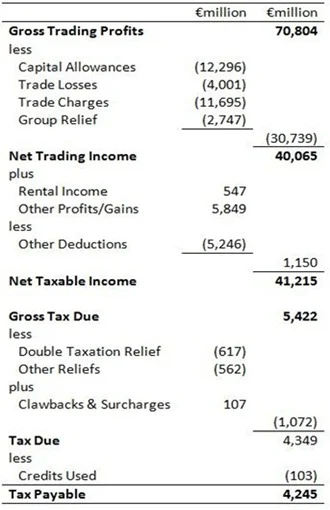
Corporation Tax Deductions

The table also shows that the effective tax rate on the €41.2 billion of “Taxable Income” in 2010 was 10.3%.  So what happened to all the profits that the US-owned “Irish-based firms” are making? 

It is not the case that US-owned firms are massively under-reporting their profits from their Irish subsidiaries to the Revenue Commissioners; it is more the case that the profits from these companies are not resident in Ireland for tax purposes.  The problem is down to the definition one uses for “Irish-based”.

For individuals, the US tax system recognises someone as being liable for US income taxes if they hold a US passport.  That is, it doesn’t matter where they live or where they work, as long as they have a US passport they are liable for US income tax, with offsetting credits received for the tax they pay where they live.  [For a discussion of this and recent changes brought in through the FATCA see this BBC article.]

For companies, US residency rules are also based on paperwork rather than activity.  Under US law, the tax-residence of a company is the country where it is incorporated (i.e. what country’s ‘passport’ does it carry).  All companies registered in Ireland are thus considered “Irish-based” under US law.

Ireland is similar in many respects but we have a slightly more intricate approach when it comes to determining corporate tax residency.  Historically, the rule was (from revenue.ie):

All companies whose central management and control is exercised in Ireland (whether it is incorporated in Ireland or not) is regarded as resident in Ireland for tax purposes.

This was revised in the Finance Act, 1999, and now:

in general, companies incorporated in the State are resident in the State.

One of the exceptions to this is:

a company that is ultimately controlled by persons resident in the EU or in a country with which Ireland has concluded a double taxation treaty or is is related to a company the principal class of the shares of which is substantially and regularly traded on one, or more than one, recognized stock exchange in an EU Member State or in a tax treaty country.

Thus, some foreign-owned, Irish-incorporated companies will not be viewed as tax resident in Ireland if they are not centrally managed and controlled here.  Prior to 1999 this was also possible for companies owned by Irish residents but the changes in the Finance Act 1999 tightened up the exceptions to the test of incorporation to foreign-owned companies only.

So what is at play here is that there are Irish-incorporated companies who, for want of a better word, “live” somewhere else.  Just like our income tax system does not levy income tax on Irish nationals who live and earn money abroad, our corporation tax system does not levy corporation tax on (some) Irish corporations who carry out their activities abroad.

There is little that is unique or unusual about this.  The issue is how our rules interact with rules of other jurisdictions, and the US in particular.

When the US Bureau of Economic Analysis says that US-owned, Irish-based companies had nearly $100 billion of profits in 2010 we actually have to go to Hamilton, Bermuda to find a good chunk of it (where Google Ireland Holdings is managed and controlled from) or Cupertino, California (where Apple Operations International is managed and controlled from).

Google Ireland Holdings is tax resident in Bermuda and pays corporation tax there on its massive global profits (the rate of CT in Bermuda is zero by the way).  Apple Operations International is tax resident nowhere and thus pays corporation tax nowhere.  Even though AOI carries out all its activity in the US, it is not resident in the US for tax purposes because it is incorporated in Ireland.  Could Irish emigrants in the US avoid US income taxes because they have an Irish passport not a US one?!? 

Both Google and Apple parent companies are liable for US corporation tax at 35% on their worldwide profits (with offsetting credits given for tax paid elsewhere).  Because of the structure of their businesses and the nature of their profits (passive income generated by intellectual property) they do not have to pay this tax liability until the profits are repatriated to the US.  In the case of Apple the profit is already in the US (and is managed in Reno, Nevada by Braeburn Capital) but because it is controlled by Irish-incorporated AOI it is still deemed “offshore”.

Google’s ability to shift profits to Bermuda where it has no activity or real presence is questionable and needs to be curbed; Apple’s ability to declare profits as tax resident nowhere is just wrong and needs to be stopped. Unilateral action by Ireland is unlikely to achieve either objective.

The OECD’s BEPS initiative may make some inroads in limiting the ability of companies to shift profits to no-tax, no-activity jurisdictions such as Bermuda.  This might impact the scheme used by Google.  The arrangement used by Apple is a bit more clear cut – companies should be tax resident somewhere.  Sinn Fein’s Pearse Doherty has made proposals in this vein over the past few months – that Irish-incorporated companies can only be non-resident here for tax purposes as long as they are tax resident somewhere else, even if that is no-tax Bermuda. 

We are probably not going to hear much at this level of detail in tomorrow’s budget but the Finance Act, 2014 may look to disassociate Ireland from the “ocean money” created by Apple.  How might Apple respond?  A likely response would be to move the management and control of AOI to Hamilton, Bermuda (which requires no more than a post-box) and do as Google does.  Of course, the US could move to treat AOI as US-resident for tax purposes (it does engage in all of its activities there) as suggested by Sen. Carl Levin back in June but the reaction by the company would probably be the same.

There will be no €12 billion of extra corporate tax revenue for Ireland but hopefully madcap notions that there could be will become a little less frequent.

Saturday, October 12, 2013

Deficit Effect of Recent Budgets

The White Paper with the Estimates of Receipts and Expenditure released at midnight last night shows that in a “do nothing” scenario the Department of Finance estimate that the 2014 general government deficit would be 5.8% of GDP (with the 2013 deficit now projected to be 7.3% of GDP)

In advance of Tuesday’s budget Minister for Finance, Michael Noonan has said that the projected deficit for 2014 will be 4.8% of GDP.  Therefore the projected effect of the measures to be announced on Tuesday is a 1 percentage point of GDP reduction in the deficit. 

How does this compare to recent budgets?

Budget Impacts

The “do nothing” scenario sees the deficit fall from 7.3% of GDP in 2013 to 5.8% of GDP in 2014.  Around three-quarters of the improvement can put down to three factors:

  1. The February 2013 liquidation of the IBRC required a €1.1 billion (0.7% of GDP)  payout under the Eligible Liabilities Guarantee (ELG) which will not happen in 2014.
  2. The 9% temporary VAT rate for the tourism sector introduced in July 2011 automatically expires on the 31st of December 2013.  This will increase VAT receipts by around €360 million (0.2% of GDP).
  3. The full-year roll-out of the Local Property Tax is expected to generate an additional €250 million (0.2% of GDP) of revenue in 2014.

That only leaves 0.4 percentage points of the “do nothing” deficit improvement to possible growth effects (and there are other minor carry-forward effects that kick-in in 2014).

If the deficit outturn for 2014 is the 4.8% of GDP that means a 1.9 percentage point of GDP improvement in the deficit would be required in 2015 to keep in line with the limits set out under the Excessive Deficit Procedure (an EDP limit of 2.9% of GDP has been set for the deficit in 2015). 

Nominal GDP growth in 2015 may be a little faster than in 2014 but probably not by much. The current DoF forecasts is for nominal growth of around 3% in 2014.  If that was repeated in 2015, NGDP in 2015 would be around €175 billion.  The April 2013 SPU forecast was that it would be €182 billion. 

Those figures indicated that with slightly higher nominal GDP growth and a €2 billion package of adjustments in Budget 2015 that the deficit was expected to fall by 2.1 percentage points of GDP.  To get under the 2015 EDP limit that is pretty much what is required. 

However, with lower nominal growth and possibly smaller carryforward effects from next week’s Budget then the level of adjustments necessary to hit the 2015 deficit limit may have to rise above the €2 billion that has been pencilled in.  Reducing the cuts in next week’s budget may merely be delaying for 12 months the effort that has to be put in to bringing the deficit down.  Of course, the growth fairy may arrive over the next 18 months in time for 2015.  Hasn’t a return to growth always just been 18 months away?

Printfriendly